
Treehouse
Flash fiction

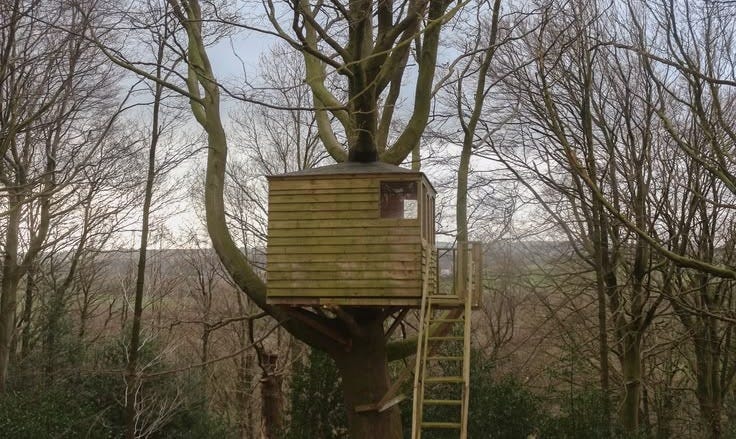
Treehouse
My grandfather was obsessed with trees.
It is said people hated going on walks with him because he would stop at every tree along the way and observe it for ten minutes. His tremulous hand would reach out, grazing the bark, gathering the sap on his fingertips and rubbing it over his skin like sanitizer. “One of nature’s free gifts,” he would say, a most brilliant smile on his face; and when he’d wake the next morning with crimson, prickly spots, he would attribute them to anything and everything but the trees.
The lore is expansive. He arrived at 146 Holloway Road a penniless youth, only to find the land as miserable as himself. But no sooner had he unpacked what little he owned than had his hands dug into the soil and begun the work. The reddest nook in autumn, the greenest in spring—that was how the home was later known, year in and year out. It became unanimous opinion that his yard was the richest and most well-kempt in the neighborhood, if not the district.
He married, became a father. Each of his children was given a name of some botanical origin: Aspen, Forrest, Rowan—and my mother, Holly. He built them a treehouse that other kids quickly envied; and though he insisted he’d built it for the children, the fact was that no one used to spend more time in it than himself. In youth, in old age; in sweltering heat and in freezing cold—my grandfather was there. Or so it’s told.
Perhaps it is true, this obsession thing. I didn’t know him until he became bedridden last month. He could hardly talk then; but when he found it in himself to exchange a few words with me, those words were always about trees.
But I dislike the word obsession. Nine out of ten times it is used, it has a negative connotation. A psychopathic kind of attachment. But why condemn what is, nine out of ten times, mere innocent passion? When did the world become such a place that one is no longer allowed to choose something to love—enthusiastically, devotingly?
It’s this thought I wrestle with as my car steers toward Holloway Road. It’s a sorry sight—a belt of increasingly neglected homes, as most have been abandoned and never found new owners. Overgrown weeds, soiled windows, empty porches that creak to the breeze.
My cousins have it that the trees have sensed our grandfather’s departure, in particular. The branches don’t sway as they did, even when the wind picks up speed; and to attentive eyes the bark has greyed. Nature is in mourning.
Pulling up in his driveway, I retrieve a keyring from my pocket and exhale. Deeply. To say that I’m glad for this would be to tell myself a lie. I would much rather be back in London—home for as long as I can recall. But when the family patriarch falls ill and guilt starts gnawing at your mother, you suddenly find yourself hauled into an airplane, flying thousands of miles to make up for lost time with a man you only know from pictures and your mother’s half-remembered childhood stories.
And with the last of my cousins moving away, I’ve succeeded them in what my mother considers a non-negotiable obligation. Once a week for God knows how long, I am to sweep and scrub and dust indoors; water and weed and trim outdoors. I am to come into this place no longer as a visitor or family, but as a housekeeper.
“It’s a house of ghosts—why even bother?” I remember protesting days ago. “Just sell it.”
My mother replied, but not with words. It was with a look I received often while growing up—a look that implied I had asked a tremendously stupid or insensitive question, so much so that I had to sit in the corner and rethink whether I deserved to call myself her daughter.
I square up and walk toward the porch, but not before sneaking a glance at the large maple tree on my far right—yellowed at this time of year. Built snugly into the embrace of its large branches is the famous little treehouse. A simple squared structure that would have taken an afternoon to make, more or less. A ladder with precisely seven steps leads up to a narrow, closed door.
In all five times I was here last month, watching my grandfather give up on life, I was not allowed into the treehouse. My mother feared it would hurt his feelings to know someone had entered it. He deserved to be the last person to have done so. And he deserved to part with that knowledge.
I don’t know about that.
**
It is well past sundown when I emerge from the house, the hems of my jeans soaked and my skin perfumed with detergent. I move stiffly down the porch; my joints protest against each step. Cleaning, when done alone, is an extreme sport.
I switch my phone’s flashlight on and cross the distance toward the maple tree. Opening the narrow treehouse door, I am met with a stuffy darkness. I straighten to my full height only for a cord to touch the crown of my head. I pull it down.
A mellow orange light bathes the little space, which I think is wide and high enough to accommodate one adult and a couple of kids at a time. There is a window on the opposite wall; for furniture, very few things: a chair, a tiny desk, a chest. On the floor are a hand saw and a hammer.
What my grandfather did here all day, I cannot guess.
I shuffle toward the chest which, to my disappointment, is locked. My eyes scan the room but there is no key in sight, so they shift automatically to the hammer.
I hesitate. This feels invasive, wrong.
But I remind myself that the man in question will never set foot in this room and will never open this chest again. And if the family persists in treating the treehouse like an untouchable shrine, whatever keepsakes it may contain will never be known. Perhaps among my grandfather’s things are little treasures from my mother’s childhood.
I pick up the hammer and catch the lock with its peen—and pull, pull at it. It budges.
The inside is surprisingly bare. There is only a thick stack of paper tied tight with a blue ribbon, and beside it—ten or so brown rags. I reach for the first, undo the ribbon. The page on top shows a beautifully drawn canary with a crown of daisies on its head.
“Your grandfather was something of an artist,” my mother once said. “He used to draw really well, and he added flowers or plants or trees to everything he made. He used to say nothing was ever complete or beautiful without them. They added aesthetic value.”
I sit cross-legged on the floor and begin sifting through the papers. The natural elements become more prominent as the sketches grow in number: there’s a bird with wooden wings, a fox with bark for fur, a creature that is half-horse, half-tree. I smile.
Then the animals are replaced with humans. A woman with leaves for hair; a man with intricate roots for feet. I put these down with a scoff, shaking my head. There’s more of the same. More and more sketches with botanically enhanced people.
Then a page makes me pause. It’s not a sketch. It’s a poster from last year, claiming that Mr. Jared Andersen of 147 Holloway Road had gone missing. The face of the deserted house just next door.
I turn to the next paper, and it’s another sketch. A man with a wooden leg. I’m about to set it aside with the rest when my hand freezes mid-air.
The face drawn on this man is the same face on the poster.
I blink. I put them on the floor, side by side, and compare. Yes—they have the same facial features; the same arch of the cheekbones, the same wrinkles in exactly the same places, identical almond-shaped eyes with the same dark hair falling halfway down the forehead.
I notice that my hand is shaking but I don’t know why. Hastily I gather the papers back in the same order and tie the blue ribbon as it was minutes ago. I’m returning them to the chest when I notice the brown rags again. I pick one up.
They are not, in fact, brown rags. They are ordinary white ones that have been stained brown—or a brighter color that darkened into this shade with time.
I chuckle, my eyes trailing involuntarily to the saw sitting beside me.
My head is suddenly loud with the most absurd suggestions. The sketches, the rags, the tools. There can’t be a connection. There shouldn’t be.
I slam the chest shut. My heart is hammering against my ribs. I don’t bother fixing the lock, because no one will be coming in here. I’ll make sure of it.
I scramble to my car a minute later and drive back toward the apartment, tightening my hands around the wheel to steady them. Every story I have ever heard about him returns to me. Stopping to observe every tree he walked by. Feeling for the bark—why did he have to feel for the bark?—and his insistence that trees made everything else more complete, more beautiful.
I park by the apartment building. My mother must be waiting, hoping to hear all about the productive afternoon I had. I force a smile to my face and climb out of the car.
To all who might wonder and ask: yes, my grandfather was obsessed with trees.
Ooohh, I love this! I thought I knew where it was going but the ending made me rethink everything! Excellent work!!
Excellent prose. Well done.