
The Notebook Spotlight: Episode III, Language Cafe
Inside the online community helping language learners speak without fear

In a recent multinational survey, 67% of the participating adults claimed they would love to learn a new language.
Only 4% of them saw it through.
The most cited obstacle was time constraints. In an inspired moment, that majority set out on individual learning journeys—enrolling in classes, keeping a streak on Duolingo, listening to podcasts in their target language, and maybe fetching a native speaker to practice with and hold them accountable. But soon adult responsibilities came knocking on their doors and life got busy. Suddenly they were skipping a class or two, the Duo owl was bombarding them with mildly threatening reminders, and both podcast and friend became subjects of an elusive tomorrow.
The response that stood out to me, however, was that many such adults believed they were too old to start—that, to achieve native-like fluency, they should have started while they were kids.1 This argument isn’t baseless; its base, however, is largely misconstrued.
It’s a fact that as children our brains absorbed language with remarkable ease. They were optimized for implicit learning: we could internalize grammatical patterns through repeated exposure and without conscious effort; and through our broadly tuned auditory systems, we were adept at distinguishing phonologies and acquiring accents. Language learning was, in a way, effortless, happening mostly through play and interaction.
But this early advantage does not mean adults are incapable of similar linguistic proficiency. The developed brain is perfectly able to form new neural connections. It even compensates with strengths children lack, such as richer conceptual knowledge and stronger memory strategies. It’s true, nevertheless, that a native-like accent remains largely unachievable. That is because our sound-perception system has already been shaped by our first language, making it harder for us to detect and reproduce foreign sounds. The good news, though, is that accent is hardly a prerequisite for fluency.
I don’t think the biggest loss we suffered growing up was of this “effortless” acquisition of language—it was of the innocence of learning. As children, we were unembarrassed of mistakes. We spoke before being “correct.” We were expected to be incomplete, and we embraced that without shame. Come adulthood, and we’ve started expecting ourselves to be compentent all the time. We back away from a language at the first sign of struggle because we fear sounding foolish. It’s almost as if we associate our skill with dignity.
We have lost the emotional openness that comes with learning. The thing is, learning has always been an act of vulnerability.
In a Substack post, Christina from Love to Lingo writes that language learning is inherently an emotional process. She refers to the famous “Affective Filter Hypothesis,” which states that negative emotions like stress, fear, or low confidence can block language input from being processed.
“When the filter is high, even comprehensible input doesn’t get through. When it’s low, we are more open and ready to learn.”
But positive emotions, she adds, are “capable of positively influencing learning outcomes more than the negative ones can hinder them.” One way to experience the former is to immerse oneself in supportive peer interaction, helping reduce anxiety and increase confidence.
Today’s digital culture has made that feasible. There has been a rise in the number of online language-learning communities, notably those gathering in Discord servers. By connecting learners from around the world for informal but creative activities, they lower each one’s affective filter—and the genuine support therein transforms the learners’ vulnerability into opportunity.
For the third episode of The Notebook Spotlight, I have spoken with the founders of Language Cafe: a cozy Discord server dedicated to supporting thousands of people in their linguistic endeavors. The sheer diversity and growing success of its community stand as a testament to the universality of language learning: anyone, regardless of age and background, is capable of achieving it.

📝Episode III: Language Cafe
Enter the Language Cafe domain into your search bar and a most pleasant view welcomes you. Overhead lights cast a soft glow over the wooden counter, behind which coffee is set to brew. The sitting area is an earthy palette: plants sit on shelves and tables of a gentle brown, hang from ceilings, and sit in corners to bask in domineering sunlight. You don’t hear it, but your mind is aware of the faint whirring of machinery in the background, and the murmur of conversation in languages you fail to identify.
This coziness is not limited to the website’s appearance; it is felt in every channel in the Discord server: in each instructional interaction, in each game played and story told.
What began as a passion project among friends has grown into a community of 20,000 members from all over the globe. Language Cafe is a snug, not-so-little space inclusive of all: a space to practice languages, offer and receive study guidance, learn about diverse cultures in immersive, interactive events, and meet people from different walks of life—different walks, but on that same turbulent road toward fluency.
Two of its founders have kindly joined me in a conversation. Kawa is a digital media graduate who, in addition to languages, is passionate about literature, art, and video games. She is a native speaker of Romanian, fluent in English and German—and is currently studying Korean and Hungarian. Her co-founder, Joon, is a project manager holding multiple international degrees. Her hobbies include traveling, listening to k-pop, practicing theater, and playing video games. In terms of language, she speaks fluent English and Spanish, and studies Portuguese and Mandarin.
These bright young women keep the community in order while pursuing other aspirations. And below they tell us all about it.

H: Welcome, Kawa and Joon! I’m delighted to feature your work on The Notebook Spotlight and introduce you to my readers.
Learning languages is an undertaking that requires passion and consistency, and you are each studying two at the moment. I’d love to know: how did your individual language learning journeys begin, and how did they bring you together?
K: I’ve been passionate about language ever since I was in grade school. I picked up various languages just because they looked interesting and I wanted to understand them (words, sentence structure, grammar—and so on). Ultimately I stuck with German since I ended up doing my Bachelor’s Degree in Germany. I reached a low B2 level. On the other hand, I’ve been learning Korean on and off throughout the years because I love the alphabet. I am a Hungarian heritage speaker, so I’m trying to learn it slowly on the side as well.
We all met during COVID-19 in a language-learning server over Discord. After about a year there, we realised we had a lot of ideas for our own community and so we ended up founding Language Cafe in 2020.
J: I was exposed to learning a foreign language during my first year of high school, as it was a requirement to graduate. I took Spanish mainly because my father used to be a beginner Spanish teacher, and he said that he could help me with my homework! During my first year of undergrad, I was introduced to the world of k-dramas and realized that I wanted to try learning Korean: my first self-taught foreign language. Due to this, I found another language-learning Discord server in 2019, where I met Kawa and some of our other friends who helped establish Language Cafe. We really enjoyed our time being involved in that community, so we wanted to try our hand at creating our own.
H: How would you define language fluency, and how does your initiative help its members achieve it?
K: Fluency is hard to define. I believe everyone has their own idea of what fluency looks like. Depending on your personal language goals, you could consider yourself fluent if you can hold a conversation in your target language, if you can understand specific jargon, or if you can write without looking up words. It really varies and it doesn’t have a set requirement. My personal idea of fluency is that I can: 1) hold a conversation, 2) understand unknown words from context or ask for explanations and understand that instead, and 3) know how to write in that language.
J: I feel like my personal definition of fluency changes depending on whether I’m thinking about myself or about someone else. I don’t think I’ll ever feel comfortable calling myself fluent in another language. It’s such a big label, and the deeper you go into a language, the more you realize how many nuances, registers, and cultural layers there are. It can feel impossible to know “enough” to confidently claim fluency, which is probably a mix of impostor syndrome and the fact that you’re always most aware of your own gaps.
For other people, though, my bar is much lower. If someone can hold even a small conversation, interact on social media, read books, listen to music, or express themselves in everyday situations the way native speakers do, I’m incredibly proud of them and swear up and down that they are fluent!
Ultimately, I think fluency is about being able to function comfortably and meaningfully in the language: communicating, understanding, and participating in real-life contexts without constantly feeling blocked.
H: Since its founding on December 6, 2020, Language Cafe has held various events. Can you tell us about your most recent and/or most successful ones?
K: I personally like the Collaborative Event in June and the latest 3 Language Jam editions.
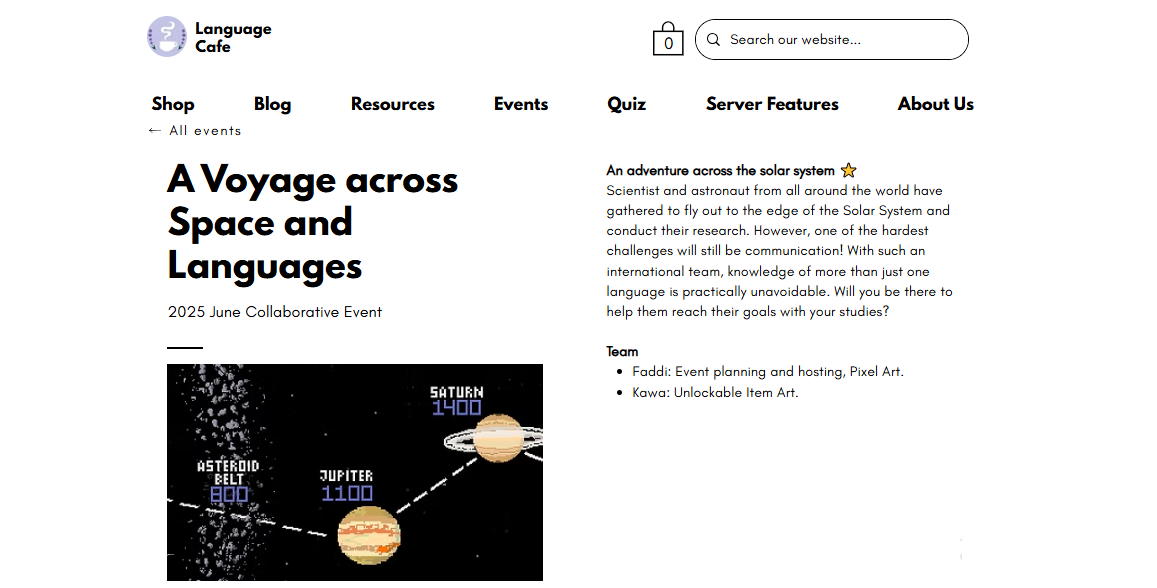
The Collaborative Event lasted for a month and the participants progressed depending on how many entries were submitted to each prompt. The story puts participants in the role of researchers that explore the solar system on a spaceship called The BRU-1. Throughout the month they had challenges related to traveling in an international space station, such as writing directions to avoid an asteroid belt, recycling paper, and fixing the ship.
The language jams are inspired by the official Language Jam events but we put a little twist to them during the last three editions: they have a dedicated story set in the same universe. The jams last for a week, during which you select a language you want to explore or focus on one you’re already learning. Each day has a challenge with three difficulty tiers depending on how much time you want to dedicate and how advanced you are in the language.
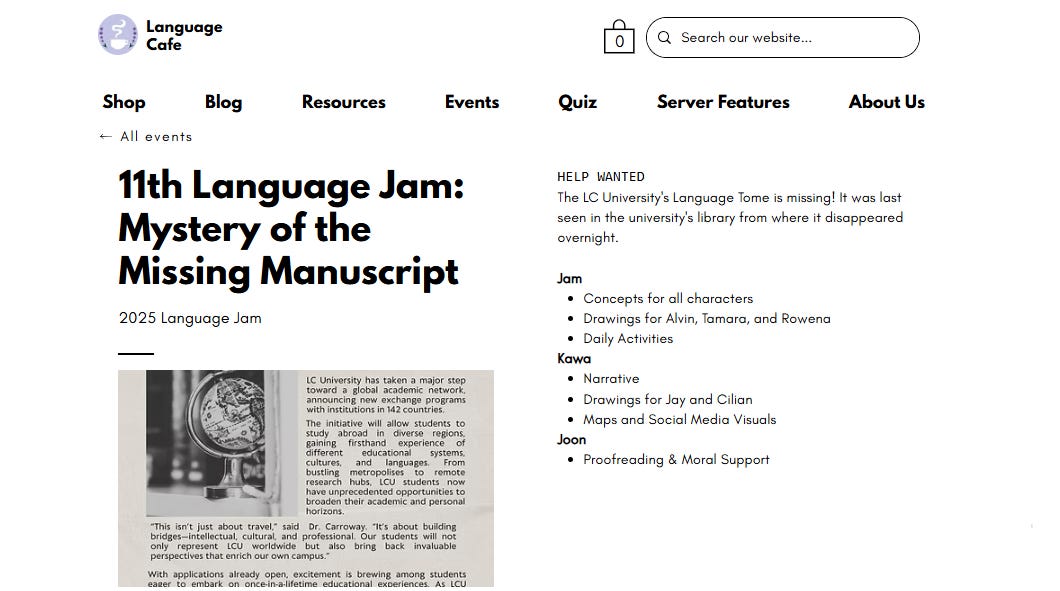
What I love about these events is that we create a story for the participants so it’s not just a simple “learn five words.” They can get immersed and we have increased motivation to draw and prepare material for them. It’s very rewarding to see how everyone gets involved in the story and learns through the activities.
J: With there being so many amazing other language learning communities on Discord, we are always trying to do something new. When I went to Japan in early 2025, I happened to be visiting at the same time as the Osaka 2025 World Expo, which was hosted by Bureau International des Expositions, and I was immediately struck with inspiration to host a virtual version in Language Cafe.
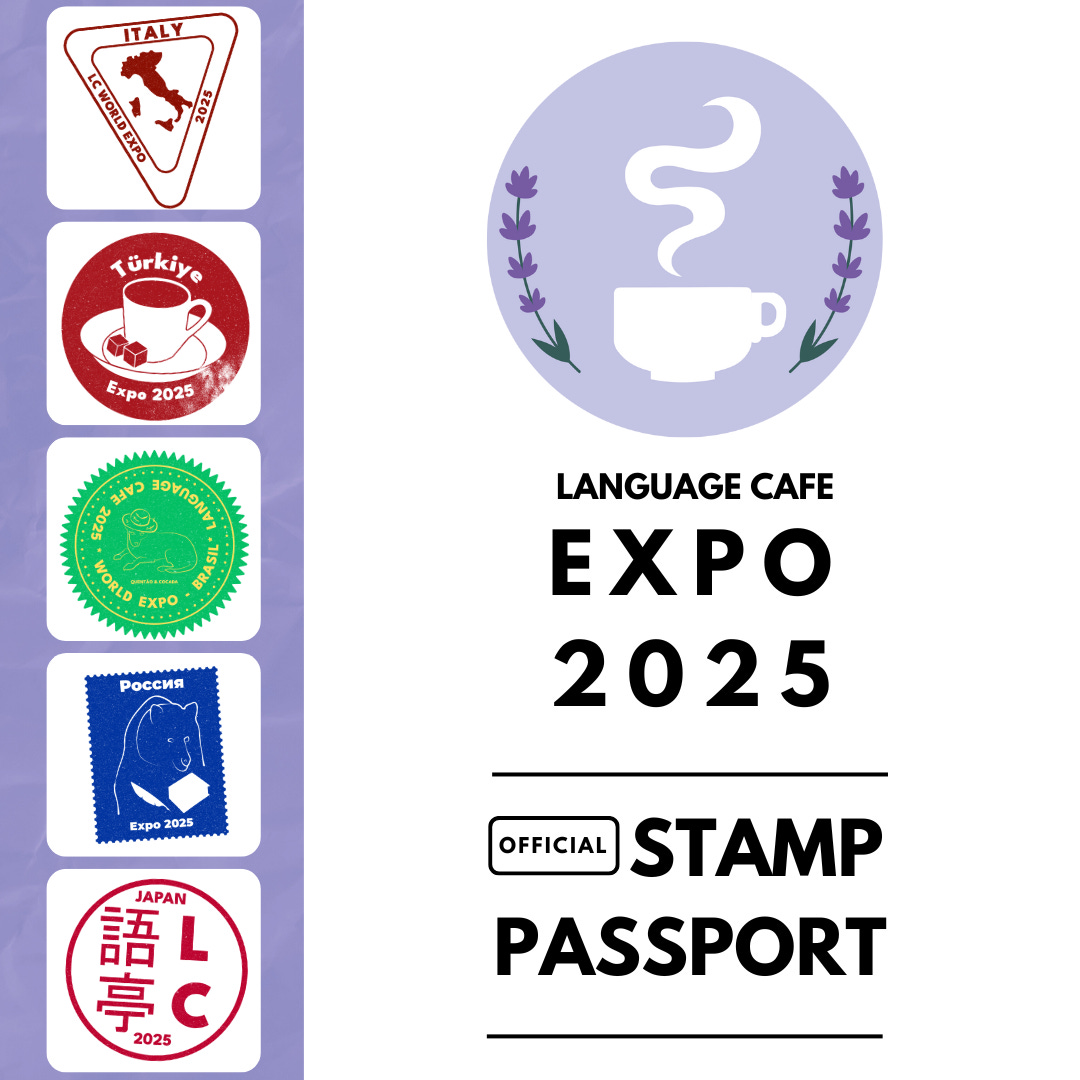
In our version, volunteers signed up to represent any country of their choosing, whether it’s their home country or a target language’s country. If there was more than one person who signed up for a country, then they formed a group and collaborated. Each group wrote about a cultural fact based on their country and an activity based on that fact. Once everything was compiled, we posted a country and its respective activity every day for 24 days total, and the participants who completed that country’s activity got a stamp in a virtual stamp book.
H: It’s come to my attention that some of your members attain specific roles on the server, such as Waiter and Barista. What do these roles entail and how are they earned?
K: These roles are essentially some of our volunteers. Waiters manage a specific channel (language or activity-specific, like reading books). They act as a moderator for a small part of the community and they create events regularly to keep learners and natives engaged.
Baristas work more closely with us founders and they assist us with server-wide events, moderation across the server, and any other work that is behind the scenes. Each Barista has their own area where they prefer to help more, so the team is dynamic in that sense.
For Waiters, we have applications open to anyone that has a good grasp of our community (spent 2+ weeks in it). Baristas are a bit more difficult to recruit as they need to communicate constantly with us and they have a higher degree of responsibility. We sometimes open Barista applications as well which help us filter the best picks.
H: A feature on the Language Cafe website that has particularly interested me is the ability to take linguistics-backed quizzes that determine which language and study technique suit you best.
Can you briefly explain the science behind language learning?
K: One of our Baristas, Jam, studies linguistics and has helped us create the quiz for discovering which language suits you best. The idea behind it is determining what linguistic features you prefer in the languages you choose to learn (Alphabet & Orthography, Phonology, Morphology & Syntax), the amount of speakers the language has globally, and more. There are 15 questions total, and as of this interview, the quiz has been taken over 20,000 times.
Our inspiration for this quiz was that we wanted to help people choose their next language in an actually helpful way (instead of the usual “your favorite food is pizza so you must learn Italian”).
The quiz has recently been updated in December 2025, with the release of our own custom dev quiz portal, with one of the major updates being that the quiz taker gets their top 10 language matches along with the match percentage.
J: The science behind language learning shows that difficulty is relative, not absolute. For English speakers, institutions such as the U.S. Foreign Service Institute, often referenced in military language training, rank languages based on how long they typically take to learn. Languages like Spanish and French are categorized as easier, while languages such as Korean, Arabic, and Japanese are considered more difficult. However, these rankings are based on averages and do not account for individual differences.
In practice, how difficult a language feels depends on a learner’s native language, previous language experience, exposure, and non-scientific factors like motivation and personal interest. For example, while Korean is commonly labeled as difficult, I personally found it fairly approachable because I enjoyed immersing myself in it. On the other hand, Spanish, which is often considered “easy,” still trips me up in certain areas, largely because I didn’t engage with it as deeply. This is why questions like “What’s the easiest language to learn?” don’t have a universal answer: the easiest language depends entirely on the person learning it.
As for study methods, effective language learning relies on structure, balance, and consistency. It’s important to practice all four skills (reading, writing, speaking, and listening), but those skills need a solid foundation. That foundation is a textbook, which introduces grammar concepts and core vocabulary in a structured way. We like to think of this as a pyramid: the textbook forms the base, and the four skills are built on top of it and supported by it. Some learners get caught up in perfecting a study schedule or believe they can simply watch TV shows and “pick up” a language the way babies do. Unfortunately, adult brains don’t have the same level of plasticity, so passive exposure alone isn’t enough.
Language learning is much closer to learning math: you start with basic concepts like addition, which build into more complex ones over time. In class, the teacher explains the concept, and then you reinforce it through practice problems. Each one is slightly different, and there is no single correct approach. Language learning works the same way: you learn a concept, practice it through exercises, and then take it out into the real world to actually use it. As long as you’re consistent, use good resources, and spend regular time engaging with the language, meaningful progress is inevitable.
H: I’d like to hear from one of your members—one of your success stories! How has the Language Cafe community advanced them in their language studies?
(Answer provided by LingLator, a certified foreign language correspondent, translator and interpreter):
I had French for six years when I was at school. I was very grateful to have been given the opportunity to learn a foreign language and have mastered the basics of it by the end of the six years.
Like with many skills though, languages are one of those things that you can so easily forget if you do not use them on a regular basis.
I tried to maintain my knowledge of the language using language-learning apps. These are indeed great for expanding on your existing vocabulary and brushing up on some grammar. The main thing I was missing, however, was the oral practice.
I think most can relate when I say foreign languages at school are all about vocabulary and grammar. Speaking is something we had hardly don, yet is the one thing that you truly need in the real world.
Since joining Language Cafe, I have made friends with fellow language learners and exchanged language learning tips which is quite motivational. More than anything, I have finally had the chance to actually speak French—not only with the other learners, but with true natives from all over the world! This has really helped my confidence when it comes to using French.
Now, I no longer hesitate when confronted with French natives at work who are struggling to communicate their needs to me in a language that is not theirs. More than once, my clients have been truly touched by my effort to speak their language.
I am extremely grateful to Language Cafe for helping me in my language learning journey.
It just goes to show that languages do unite.
H: What have been the greatest challenges to running Language Cafe?
K: I’d say putting systems and processes in place. I learned a lot throughout the years about recruiting, managing and communicating with volunteers, but also making sure we have clear roles, responsibilities and deadlines. Some of the hardest moments were when we realised we didn’t have enough time until an event’s release, so we had to spend entire days of our personal time to make sure we had all the content needed. Now we add buffer periods to any event planning to avoid that.
J: I would say that one of the hardest parts was truly getting started. With many language-learning communities already existing and some having hundreds of thousands of members, it can be difficult at first to find your footing and identify what sets you apart from the crowd. Building something from the ground up requires a lot of trial and error before you really understand what your community needs and how you want it to function.
Another ongoing challenge is keeping people engaged. Even though language learning can be fun, it is still studying at the end of the day, and even the most enthusiastic learners have periods when their motivation drops. One of our main goals with Language Cafe has always been to make language learning feel less isolating by creating a supportive space for people who feel lost, discouraged, or unmotivated, and helping them push through those low points instead of giving up entirely.
We also see a lot of fear around actually using the language. Many members are hesitant to speak or practice, whether that means texting in a language channel, joining a speaking event, or even reading aloud to practice pronunciation. People often say they’ll “come back when they know more,” which usually never happens. Starting a language is extremely daunting, and the fear of making mistakes can be incredibly discouraging if it isn’t addressed early on.
Finally, there are broader logistical and educational challenges. With members spread across the world, time zones don’t always align, so scheduling events that work for everyone is difficult. Often, two-thirds of the community can attend while another portion simply can’t.
On top of that, we sometimes have to teach people how to learn a language in the first place. Many come in with unrealistic expectations shaped by apps that promise fluency in minutes a day or by influencers who oversimplify the process. Both of us have been in that position before, so helping people unlearn those ideas and adopt healthier, more sustainable approaches to language learning has become a core part of what we do.
H: How do you envision collaborating with other language-learning initiatives, locally and globally?
K: I’m imagining all kinds of collabs: hosting events, releasing an article or social media campaign, long-term partnerships, discussing and finding solutions to our common issues and so on. We’re open to ideas and establishing new partnerships. Currently we have several projects in this direction: affiliate offers with language-learning apps/platforms, partner teachers that have qualifications and have taught in the community, our own digital magazine for artists and creatives within our community, and a partnership with another digital magazine.
J: I think it would be amazing to collaborate more with schools and educational institutions, especially to show learners that you don’t need native speakers in your immediate environment to successfully learn a language. That was personally one of my biggest mental hurdles when I started learning Korean. We’ve already seen some schools engage with our study method quiz, and being able to help younger learners start off on the right foot would be incredibly rewarding. Traditional language classes are great for structure, but they often don’t teach students how to continue improving independently once the class ends, and that’s something we’d love to help bridge.
Beyond that, I’d love to see more in-person collaborations, such as language cafés, exchange events, or even participating in conferences like the Polyglot Conference. As the world becomes increasingly digital, it’s easier than ever to find free resources and connect with native speakers globally, and we want to emphasize that learning a language doesn’t have to be expensive. Community-based initiatives like ours can play a big role in making language learning more accessible, supportive, and sustainable for learners everywhere.
H: Does the Language Cafe community seek volunteers? If yes, what kind of services are you looking for, and what can volunteering members take away from the experience?
K: We accept volunteers all the time. We generally like to get to know the person and their preferences before deciding on a role. Several projects started through someone simply reaching out and asking if they can help in a certain direction (hosting one-time events, offering language lessons). A volunteer actually received a scholarship through the articles they wrote for our blog.
On a regular basis, we accept Waiters (channel-specific moderators), teachers, translators, and event suggestions. In return, we offer a volunteer goodie pack: certificate of volunteering, letter of recommendation, and assistance with resumes.
Being a volunteer in Language Cafe is flexible. We’re open to exploring new projects and directions, so there is space for growth and learning. Even on a personal level I have learned so, so much throughout the years and expanded my skillset drastically.
J: As Kawa mentioned, we have a variety of volunteers who participate in the community in different ways. These are members who have spent time in the community and want to get more involved, whether to give back, gain experience, or build their resumes. Many of our members are students or young professionals, so we try to make volunteering mutually beneficial by offering opportunities to learn skills like event planning, moderation, communication, and community management.
We also offer temporary and task-based roles, such as teaching beginner lessons, translating blog articles, or helping host specific events. These roles allow members to contribute in focused ways while gaining practical experience.
H: What’s next for Language Cafe?
K: We aim to maintain our community for many years to come. Some projects we’re planning for are finding more interactive ways to practice languages and stay motivated while studying, producing video content to aid learners, and crafting a tool for study focus.
J: Motivation is one of the biggest challenges language learners face, and as learners ourselves, we really want to build things that genuinely help people rather than quick, profit-driven tools. We’re often approached to promote AI-based language-learning apps that overpromise and underdeliver, but our focus is on creating resources that are practical, realistic, and actually useful.
In the near future, we’re working on another quiz designed to help learners understand what type of language learner they are, identify their strengths and weaknesses, and learn how to address them. Looking further ahead, we’d love to expand our free classes program, collaborate with more organizations, and continue developing tools and initiatives that help people progress not just in their language studies, but also in their personal and professional lives.
“It goes to show that languages do unite.”
People learn languages for every kind of reason. There’s someone out there moving countries soon, while someone else has just been offered a job that requires a level of proficiency in a foreign tongue. There’s a person studying their loved one’s native language because they want a better understanding of their culture; someone else is doing it entirely out of passion—for self-improvement, or out of curiosity.
Language Cafe has united thousands of language learners with these and more stories to tell—and it’s only getting started.
Kawa and Joon have said it, and happily do I repeat it: volunteers are always welcome, and so are those with services to provide. You may reach out by accessing the official Language Cafe website, or following them on Instagram.
The community will be delighted to have you.
Until next time,
Heba
Know a language enthusiast who might like to learn about Language Cafe? Share this post with them!
What are your thoughts on Kawa and Joon’s work so far? They’d love to hear them:
Absolutely brillaint work on highlighting how Language Cafe tackles the affective filter issue. What really stands out is how they reframe learning from performance anxiety back into playful experince with those story-based events. I tried joining a language exchange group a whlie back and felt that exact fear of sounding incompetent, but communities like this that build in vulnerability as a feature rather than a bug seem like they'd shift that whole dynamic. Guess its less about having perfect grammar and more about just dunno, not letting shame kill the spark.