
The Notebook Spotlight: Episode II, The Accessible Archivist Coalition
Meet the young archivists reimagining access to modern history

“History is not a recipe book; it is a record of human folly and achievement.”
—Arthur Schlesinger Jr., American historian and social critic
────୨ৎ────
When the topic is history, we tend to think of the collective. We condemn the wars that have plagued humanity across time and place, lament the lives lost to natural disasters, criticize the political, economic, and social powers that have kept populations oppressed for generations—among much else. Similarly, we celebrate when a truce is announced, a disaster controlled, a regime overthrown.
All that is well to do.
But it often escapes us that the personal is history, too. The relationships you’ve failed to show up for, and those you treasured; the illness that had you bed-ridden for days, but which you healed from; the many tests you bombed for the degree you dreamed of, which you still earned one sunny spring day—these may sound inconsequential, but they’re the follies and achievements that constitute your history.
Like the collective, individual history is made up of moments worth remembering—such that failures are not repeated and successes not undermined.
What are you doing to remember yours?
And how do we keep from forgetting ours—the collective?
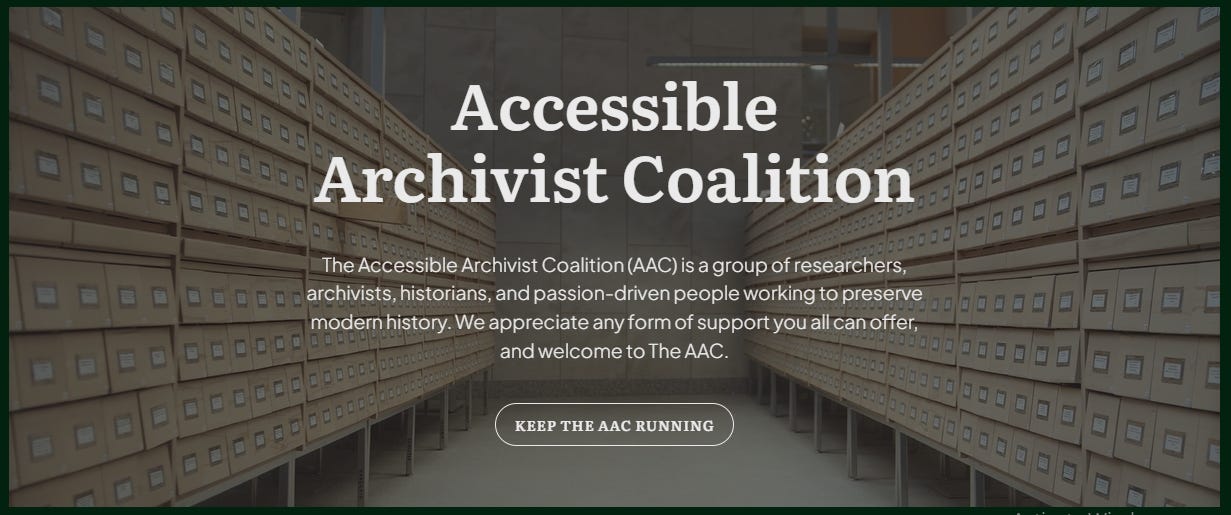
For the second episode of The Notebook Spotlight, I’ve had the pleasure of talking to the co-founders of The Accessible Archivist Coalition (AAC). This group of passion-driven researchers, historians, and archivists has come together for the purpose of preserving modern history, reminding us that all which we live—that the extraordinariness of the communal and private alike—deserves outliving us.
📝Episode II: The Accessible Archivist Coalition (AAC)
“We started working on this with humanity in mind, nothing else.”
—The AAC team
This is the age of uncertainty: news sources are prone to bias, citizen journalists often prioritize popularity and sensationalism over factual reporting, and anyone sitting behind a screen can use AI to fabricate not just knowledge, but also experiences. Finding authentic voices nowadays is, as the old idiom goes, like looking for a needle in a haystack.
The AAC is diligently working to turn that haystack into a free, accessible digital archive.
It began with two young people inspired by loss, learning, and the need to preserve what matters.
At just nine years old, Alexis Durante-Tierney was personally affected by Hurricane Katrina. Her grandparents’ home, where she was raised, was lost in the storm. Along with it went the bulk of what she knew and loved.
When she discovered there was a field of study that could teach her to preserve what’s important, she jumped right at the chance to learn—and there began her fascination with the craft of archiving. With time, she formed a large following on TikTok, where she shares her knowledge on archiving and the conservation of historical documents. Her most notable work is a large collection of documentation on Hurricane Katrina, which she tirelessly strives to educate her audience about.
Matthew Beard eventually reached out.
A modern historian, Matthew traces his passion for the subject back to his junior high school teacher, Mr. Samuel Meade. Though he had several good teachers prior, he explains that Mr. Meade presented history in a way that enraptured him with it completely. He began digital archiving as a personal project in 2025. Before long, he realized he needed help organizing and documenting his work—so he contacted Alexis. And from that connection, the AAC was born.
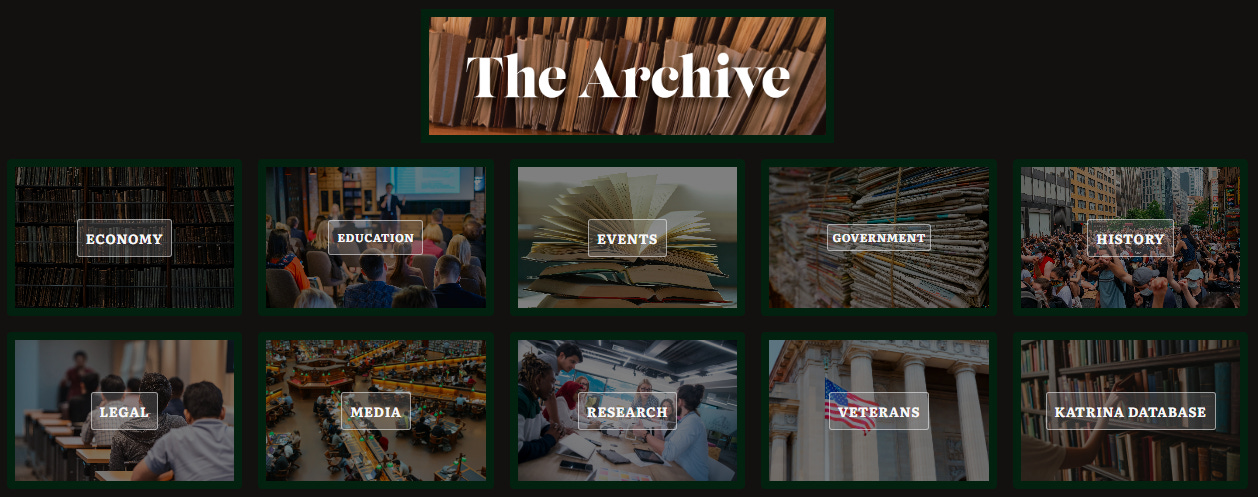
Though in its early stages, the Coalition has amassed a good number of volunteers and its website went live on September 15. The archive is routinely updated and divided into collections, facilitating navigation for users seeking credible information on particular topics: economy, education, government, history—and many more—and each consists of sub-collections (there’s even one called Palate Cleanser for lighter topics, such as pop culture).
The AAC’s work, if well supported, is set to benefit us greatly. But it’s also set to benefit future generations—those who, decades and more from now, will know where to look when wanting to read about the struggles and successes we’re witnessing. About our history—to read, to learn, and to hopefully grow from it.
I’m delighted to share with you the conversation I’ve had with Alexis and Matthew, in which they talk about the AAC’s origins, mission, and their hopes for its future.
H: Welcome, Alexis and Matthew, to The Notebook Spotlight! I’m thrilled to have you on this episode and to introduce my readers to the remarkable work of The Accessible Archivist Coalition.
Every initiative has an origin story. How did the idea for the AAC come about and how did the team first come together?
A: Matthew and I joked that we started this with “a Dropbox and a dream” because the only thing we had at first was a large Dropbox account where we’d collect and deposit the day’s news articles alongside our respective research. After a while, it became bigger than two people could handle alone.
I began posting about it on TikTok, asking anyone who’d like to volunteer their expertise if they’d like to help. Incredibly, we got an influx of messages: “I do web design, I’ll help make your site”/“I build databases, let me help you on the back end”—and so on and so forth, until we had loosely assembled a team to help us. We’re all volunteers, and most of us work full time in addition to this project, and it is constantly growing and evolving thanks to the help of our incredible Coalition team members.
M: Before I had the pleasure of working with Alexis, I was working by myself with a crash course in encryption to keep things safe. I was looking at news articles and official documents that were soon going to be taken away, trying to build a web of connecting dots. After a few months I was becoming overwhelmed and knew I needed help. I reached out to roughly twenty people who had an online presence and whom I thought would be of aid to what I was doing. After no replies I messaged Alexis again, and it caught fire from there.
H: The AAC has quickly grown into a community of dedicated volunteers, including professionals and hobbyists alike. In your experience, how accessible is the field of archiving today? And what steps does your initiative take to make it more inclusive for those without formal training?
A: I do believe the field of archiving is more accessible than ever due to its digital nature today. Anyone can learn how to properly preserve their own information, both digital and physical, through knowledge available online, often from top institutions and their libraries. Archiving is a field that does require a ton of study because it is not only practical, but theoretical. Building archives takes training, but it also takes a willingness to learn and an openness to trying new things in addition to the tried and true.
We work to make things more inclusive for our team by providing them with tutorials (I recently co-wrote an article on how to preserve your digital life, linked below), external references (we have a “tips and resources” channel in our discord for this reason), and open collaborative workspaces for people with varying areas of expertise to learn from one another and help with differing aspects of the project.

H: Could you walk us through your archiving process, from collection to publication? How do you decide what materials to include, and what measures do you take to ensure their accuracy and diversity of voices?
A: I always use the steps of standard archival practice to begin: 1) conducting a survey of the records and seeing what we have, 2) appraising them (do we have anything like this already? Does this add anything substantial to our collection?), 3) arranging them (what category does this fall under? How can we help people find it easily?), 4) entering descriptions and metadata (making things searchable), and finally, 5) promoting outreach so people know about our collection. These steps guide all archival projects and are the way I learned to keep a workflow going, so I always start there.
My background focuses on the amplification of marginalized voices, so when acquiring information for the archives, I ask myself if we have any information from this lens, and what else we can do to round out a collection with objects from those who may not have their stories depicted elsewhere.
M: My process, though now a bit more refined, has stayed roughly the same since I began solo. Though Alexis covered the important steps of gathering and comparing to what is already collected, I like to look at things through a lens of ‘this may seem unimportant to me, however this could be someone else’s crown jewel in the future.’ We have often told our researchers that nothing is off the table when it comes to what we want to gather and archive.
In terms of determining accuracy, our TRACE team, which handles research and cataloging efforts, has worked to lay out some foundational reliability checks for things such as news sources and articles. One of the earliest members of my team spent quite some time cross referencing several different filters and grading scales to create a list of news sources and their credibility. These are listed with a score, as well as color-coded in order to guide the researchers when gathering sources specifically from news outlets. We are working on similar projects with other resources for the future as well.
H: What are the greatest challenges facing digital archiving today—whether technical, ethical, or institutional?
A: Funding cuts and administrative restrictions passed on academia, particularly the humanities, are a detrimental issue right now. Without grant funding, jobs are rapidly slashed, and collections sit collecting dust because nobody is able to archive them. Projects go unfinished because people in power are deeming them “unimportant.”
M: The largest issue that we have faced in the research and gathering of media can be boiled down to being faster than the wave of deletion or takedowns. We have to almost predict the future sometimes when it comes to topics and fields that we need to preserve. The member I mentioned earlier from the TRACE team is currently working on a massive project built to do exactly what I stated. Predict. It’s impressive and really going to be a massive help not only to us, but to the public as a whole in the future.
H: Artificial intelligence is transforming many fields (and compromising many others). What role does it play in digital archiving? Do you see it as a helpful tool or is it something that needs avoiding?
A: Truthfully, there is no consensus on AI in archives yet. People have discussed its possible benefits in creating metadata or organizing subcollections, doing menial labor that is a tedious part of our job. But the field of archiving is so people-focused and requires such an eye that only a human could do it properly. A computer should never tell a person what artifact is “more important” than another.
For example, AI might look at two pieces of paper and deem them both “non-essential” to your archive, but a person can differentiate between the two in more granular detail. Perhaps one is a handwritten note from your late grandmother, and the other is a copy of a drugstore receipt. If there is an error, the AI might deem both “non-essential” to your archive, whereas a person taking the time to go through these papers would be able to take the action needed to keep the handwritten letter safe. Even one instance of that happening, of that sentimental, important object being lost by a computer, would be one too many.
H: Online archives are often inaccessible (academic paywalls and restrictions, for example). How does the AAC work to make information more publicly available?
A: Our desire and mission has always been to give people information for free. We don’t publicize any information that would have potential copyright issues, for legal reasons, but we do take publicly accessible information that has been scattered across dozens, if not hundreds, of websites and compile it in one place for ease of access. For example, when public government websites were wiped from the internet, I went through and compiled every single record about Hurricane Katrina I could find, and backed it up on multiple drives (another important facet of archiving). Katrina is not only an event that affected me personally—it is my focus of study as a scholar. To have those records permanently erased would be detrimental to my research. So instead, I spent weeks doing what I called “guerrilla archiving”—going to every single site I could and grabbing everything, organizing it into categories and subcategories, and eventually, publishing it on our Accessible Archivist Coalition website database. Though not all of what I’ve saved is publicly accessible right now, we are working to get as much of it as possible on our front-facing site. It is, unfortunately, a massive task for a group of volunteers, and will take some time, but slow and steady wins the race, as they say.
H: Given that the AAC archives data on national and international events, how do you envision collaborating with other organizations (academic, governmental, cultural, or others) on a global scale?
A: It would be a dream to work with established institutions as we grow. I’d love to do some sort of pop-ups at various museums and academic libraries and the like; to feature our work and to make connections with other archivists. The most important thing to me is making people understand that if you are passionate and you work to educate yourself, you can create anything. We work hard to create connections with the public and to make people feel like their stories are being heard at a time where screaming for justice feels more like screaming into the void.
M: Piggybacking on Alexis, I would love to see the AAC be used in the same sentence as JSTOR or WORLDCAT in academic settings in the future.
H: Looking back on your journey so far, what has been the most rewarding or unexpected part of building and running the AAC?
A: It’s been beyond rewarding to hear that we’ve helped other people in their research or inspired them to work toward their education. Nothing is more fulfilling to me than knowing something I’ve done has helped someone get over a rough patch in their journey. I know as well as anyone that it’s not easy, and more often than not we find struggles we have to overcome, but knowing that I’m not the only person in the world that feels strongly about this keeps me going. I’ve found a lifelong friend in my co-founder Matthew, and I’m beyond lucky to have a group like the AAC helping me in this endeavor. They are all brilliant, kind, hardworking people whose focus is making the world a better place. I couldn’t ask for more than that.
M: Firstly I’m also glad to have found Alexis. She has definitely become a life-long friend, and our shared passion for this is what brought us together. I will always value that very highly when thinking about the AAC, or the journey we have made so far.
In terms of “unexpected” I would say that the reception and response we got was quite the surprise. I know that Alexis has been working day and night for years building what she has with the Katrina Database and her online presence, so I expected some interest from her followers. However, we checked in on our mailing list sign-up we sent out, and it very quickly reached 1000 free subscriptions. That blew our minds. Just the passion of so many people to not only support what we are doing, but to have a hand in doing it. People are beginning to see the value in preservation, at least on a larger scale, and it seems perhaps they just needed a place where they could look for it.
H: Finally, what’s next for The Accessible Archivist Coalition? How do you see your work evolving in the coming years?
A: Lately, we’ve been taking it a day at a time, waking up to more and more “unprecedented” news events that we work to preserve so they don’t get lost in the shuffle. I think for me, what I want more than anything is to have a place to work on my research full-time and to bring the AAC to a state where we are fully funded so we can begin paying the volunteers that have put so much incredible work into this project. I want to create a place where people are excited to learn, excited to find out something new and dive into it headfirst. I want to guide people to a place where education is something they truly want to pursue, not something they feel an obligation toward. I want The Accessible Archivist Coalition to grow into a worldwide movement where history is written by those living it. For the first time in recorded history, we all have a way to preserve our lives. We deserve to do it.
M: Though we are now in a state of “maintain” rather than rapidfire development, I hope to see our steady progress in the different areas we are working on to settle and stake their claim in the archiving space. In the future I would hope that we can be a resource for not only academics, but for everyday people, who simply want to have somewhere they can look back on certain moments or events in life and history. A place where people can educate themselves on whatever they see fit (so long as we have it at that time, and if we don’t, we will). I’m hoping to get a repository of sorts established so that we can gauge what the wider public would want preserved. Though we are focusing on more “at-risk” topics right now, we aim in the future to have a wide variety of avenues people can explore to learn more about history, without the lens of bias or censorship.
Ultimately, I would say the goal is what we have stated already: to become a fully funded organization that can provide information to whoever seeks it, for free, forever. Information shouldn’t cost anyone anything, if you have the desire to learn, and that’s more than enough payment for me.
────୨ৎ────
Speaking with Alexis and Matthew made one thing clear: archiving today is no longer just the work of institutions. It’s the work of communities, of individuals, of anyone refusing to let their stories be erased.
The AAC is doubtlessly doing incredible work—and it’s far from complete. It takes combined effort to compile history, just as it does to make it. On the website is a volunteer form, accessible to all. If you have an interest in contributing, do not think twice.
Preserving information digitally is paramount, whether it’s your own history or the world’s. The AAC’s door is open: take that chance to learn.
Future you thanks you.
The future generation, too.
Until next time,
Heba
────୨ৎ────
Support The Accessible Archivist Coalition by following up on their website and social media:
Official website: https://theaac.org/
Instagram page: @accessiblearchivists
Thank you for reading to the end of Episode II!
Know someone who might appreciate learning about the AAC? Spread the word:
Don’t forget to subscribe to The Humanities Notebook to learn about many more inspiring initiatives!
Love your perspective, your values, your intelligent and thoughtful work! Subscribed—and sharing my North of 80 posts link here—to a recent one. I’m 82 and writing ,creating,sharing is —for me—a necessary way to navigate these times. Please take a look—and May all be well and go well with you
https://open.substack.com/pub/davidofallon/p/a-culture-for-life?
Such great work they're doing! Thanks for sharing this conversation <3