
The LOTR Reading Diaries: Book Five, 'The Return of the King'
The beginning of the end

This review is preceded by:

The Darkness has begun. There will be no dawn.
I cannot imagine hearing these words as a cheerful little hobbit, especially when said by the one in whom all hope lies. My courage would fail me; my composure, crumble.
But Pippin does not waver as the great Gandalf delivers these tidings. He maintains a collected countenance, displaying a level of maturity not seen in him before. There is, on the one hand, his awareness that their current predicament could not have been avoided. All decisions would have come down to this. On the other, there is his determination to face it.
“No, my heart will not yet despair. Gandalf fell and has returned and is with us. We may stand, if only on one leg, or at least be left still upon our knees.”
This way opens Book Five.
Minas Tirith, known once as the city with unbreakable walls, still stands—though wary, uncertain, and like most of Middle-earth, slowly fading in Mordor’s deep, ever-spreading darkness. The enemy’s fleet approaches. Destruction is a promise the people of Gondor wish to at least postpone.
In the distance, Rohan prepares to aid them: King Théoden leads a muster of stout men toward the enemy-littered battlefield, vowing to risk it all in the city’s defense. Aragorn guides his company through the Paths of the Dead en route to the same destination.
War arrives to test the heart and steel of Middle-earth’s last defenders. This is the beginning of the end.
The Return of the King is in its first two hundred pages a balanced combination of action and depth. There are battles fought with the sword, others with the heart. Each character—from hobbit to man (and woman); from king to wizard—is tossed into the raging storm. And all the while, the deeds of the (new) Ring-bearer remain unknown.
This part of the LOTR Reading Diaries dissects the remarkable happenings of the war on Minas Tirith: the valor of the oft-overlooked, the defeat of great leaders, and the staggering power of faith in the bleakest of circumstances.
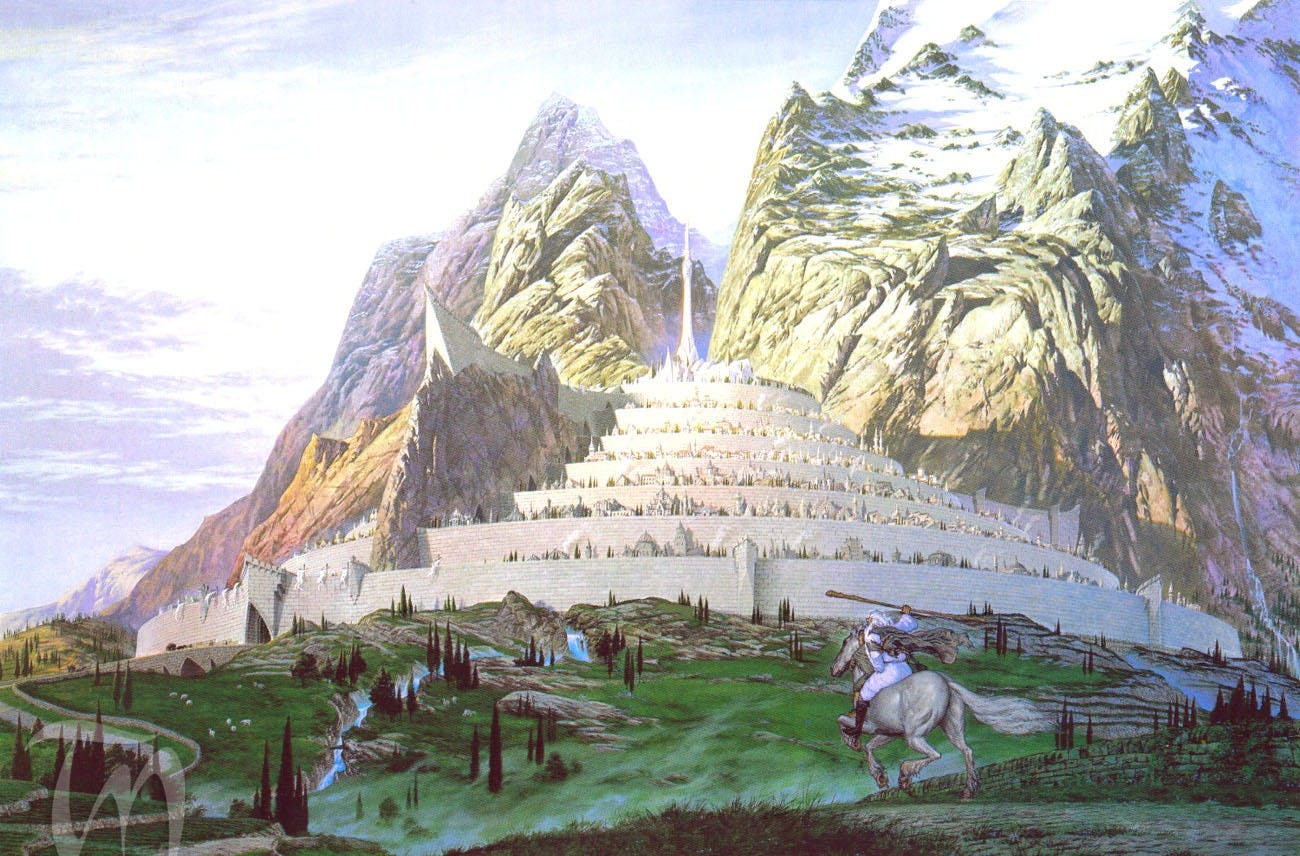
Pelennor: the hour of unlikely heroes
Middle-earth’s charm is in its lore. There is a history to every pillar and stone; every blade of grass has seen days of sorrow, others of joy. The air smells of music and poetry, which tell tales of long ago—tales that have found in tender hearts a home. I think it pleasant when the characters pause to sing a few verses. It reminds that beauty and light can still be found in the darkest of times.
Many such verses narrate glorious deeds, good and evil. In most, the accomplishments are traced to individuals of diverse kinds, but of a particular gender: Men and male Elves of esteemed lineages; kings and warriors and wizards. Indeed, if good prevails in the current war, future generations will be singing of Aragorn, Gandalf, Éomer and Théoden, Imrahil, and the sons of Elrond.
But the battle on the Pelennor Fields adds a woman to this list.
The narrative has so far introduced few female characters. In terms of significance, I believe Arwen hardly counts. It’s true that as the daughter of Elrond she is of high Elvish lineage, and among the most noble figures remaining in Middle-earth, but she has offered nothing to the plot. She appears briefly at the feast following Frodo’s recovery in Rivendell in Book Two (wow, that feels like ages ago), and Tolkien’s description emphasizes only her presence and beauty. Being a fair figure that resembles Lúthien, the legendary Elf-maiden of ancient tales, Arwen is established as myth-like rather than a character with agency. She may have lived an adventure we don’t know of; or, perhaps, she might have something interesting in store in her future. Up to this point, however, we know and have seen little of her. I hope (but doubt) she’ll show again in the next and final Book.
Galadriel is a different story. I have reflected on her character in previous parts of this series (Book Two; Book Three), and will thus not be dwelling long on what makes her great. But I like to think that the deficiencies in Arwen’s characterization are substantially compensated for in hers. Like the former, Galadriel is a High Elf and described as fair, but that is hardly her most important quality. She’s associated with ancient wisdom and possesses exceptional powers of perception and foresight. Her presence demands respect and attention, such that even powerful figures (ex. Aragorn) defer to her, speak carefully around her, and take her word as final. Her safekeeping of the Elven Ring Nenya only aligns with the role she already performs: that of protection—of Lórien, and of Lórien’s friends. When Frodo and Sam, caught in Shelob’s trap, invoke Galadriel’s name, her help arrives in the form of a light. Her name summons moral authority against a creature of primal darkness, strengthening the hobbits’ will and allowing their phial to blaze with a power Shelob cannot bear. I cannot help but compare this to the enigmatic Tom Bombadil: his aid, though localized, similarly arrives upon invocation.
There’s really much more to say, but this section is meant to focus on the third female character to join the story.
Enter Éowyn: Lady of Rohan, King Théoden’s niece.
Book Five isn’t the first time we see her. In Chapter 6 of The Two Towers, she appears at the Company’s arrival at Edoras, during the conference between Théoden (or, really, his mouthpiece Wormtongue) and Gandalf. She sits by her uncle, silent but watchful. Her features are described as both beautiful and grave, an unmistakable sadness in her eyes as she regards the wizard and his followers. The first impression Éowyn gives is of a background character—of, simply, a family member entrusted with the care of her aging, “incapacitated” father figure.
But it is in Book Five that we learn of her depth and valor.
When Aragorn resolves to take to the Paths of the Dead, Éowyn requests to accompany him and his riders. He turns her down, reminding her of her duty toward the people of Rohan—to those who have stayed behind, and those who might from battle one day return. Thus develops what I think is the most interesting exchange in this Book:
“Shall I always be chosen?” she said bitterly. “Shall I always be left behind when the Riders depart, to mind the house while they win renown, and find food and beds when they return?”
“A time may come soon,” said he, “when none will return. Then there will be need of valour without renown, for none shall remember the deeds that are done in the last defence of your homes. Yet the deeds will not be less valiant because they are unpraised.”
And she answered: “All your words are but to say: you are a woman, and your part is in the house. But when the men have died in battle and honour, you have leave to be burned in the house, for the men will need it no more. But I am of the House of Eorl and not a serving-woman. I can ride and wield blade, and I do not fear either pain or death.”
“What do you fear, lady?” he asked.
“A cage,” she said. “To stay behind bars, until use and old age accept them, and all chance of doing great deeds is gone beyond recall or desire.”
“And yet you counselled me not to adventure on the road that I had chosen, because it is perilous?”
“So may one counsel another,” she said. “Yet I do not bid you flee from peril, but to ride to battle where your sword may win renown and victory. I would not see a thing that is high and excellent cast away needlessly.”
“Nor would I,” he said. “Therefore I say to you, lady: Stay! For you have no errand to the South.”
“Neither have those who go with thee. They go only because they would not be parted from thee—because they love thee.” Then she turned and vanished into the night.
—Chapter 2, The Passing of the Grey Company
Tolkien does something remarkable here: he depicts the tension between Aragorn and Éowyn in a balanced manner, such that the former is not vilified and the latter is not dismissed as irrational or foolish. Her argument is given weight in the face of authority.
As I see it, Aragorn’s refusal to take Éowyn in is not intentionally prejudicial. Prior to their interaction, it is more than once claimed that the Paths of the Dead is a place no living person should enter—whether man or woman. Even the seasoned warriors in his company cower at the mere mention of the name. His decision can thus be understood as a form of existential caution.
He is respectful in his address; in no instance does he belittle or demean her. He implies it is because he deems Éowyn as “a thing that is high and excellent,” (to quote the Lady herself), that he cannot see her “cast away needlessly.” But what I believe he intends to say is that, unlike his men, Éowyn is simply not expected to make this sacrifice. A lack of expectation is, to Aragorn, reason enough for a lack of execution.
And yet—
Éowyn interprets his refusal as a slight. We realize she is not wrong for feeling this way when we remember who she is: a woman, yes, but a woman of the House of Eorl—and a trained warrior. She is not some sheltered girl who has all of a sudden become entranced by the idea of doing something great. She has been trained, likely all her life, for the opportunity to serve her kingdom in ways beyond the domestic. Apart from her sex, she is the equal of every warrior in Aragorn’s group. All she asks of him is to treat her as such.
Actually, there is another aspect in which she differs from these men: she is not scared. Not of the Paths of the Dead, not of battle.
What I see in this chapter is a subtle demonstration of how their society’s gendered expectations restrict both its men and women. The men, on the one hand, feel obligated to follow Aragorn even when their hearts do not desire it. Because they’re men. Éowyn, on the other hand, is obligated to stay behind even when her heart does not desire it. Because she’s a woman. The men are allowed no agency to retreat; she, no agency to fight.
So although Aragorn tries to behave as a leader balancing risks, he still embodies gendered paternalism—a kind of benevolent sexism.
But Éowyn refuses to be overlooked.
I was delighted when, in the middle of battle, the young warrior Dernhelm is revealed to be the Lady in disguise.
But there is something else that pleased me: en route to the Pelennor Fields, an undercover Éowyn takes a similarly overlooked Merry under her wing. The hobbit, though sworn into the service of King Théoden, is commanded to stay behind. It is revealed his service had been implicitly limited to mere companionship. In other words, Merry’s only duty toward the king was to entertain him with tales of the Shire.
“I won’t be left behind, to be called for on return!” said Merry. “I won’t be left. I won’t.”
The hobbit feels as embittered as Éowyn, as the two are prejudiced against for reasons beyond their control: stature and gender. In Merry, the Lady sees a fellow victim. She sees an ally.
And together, this underestimated pair achieves the battle’s greatest deed.
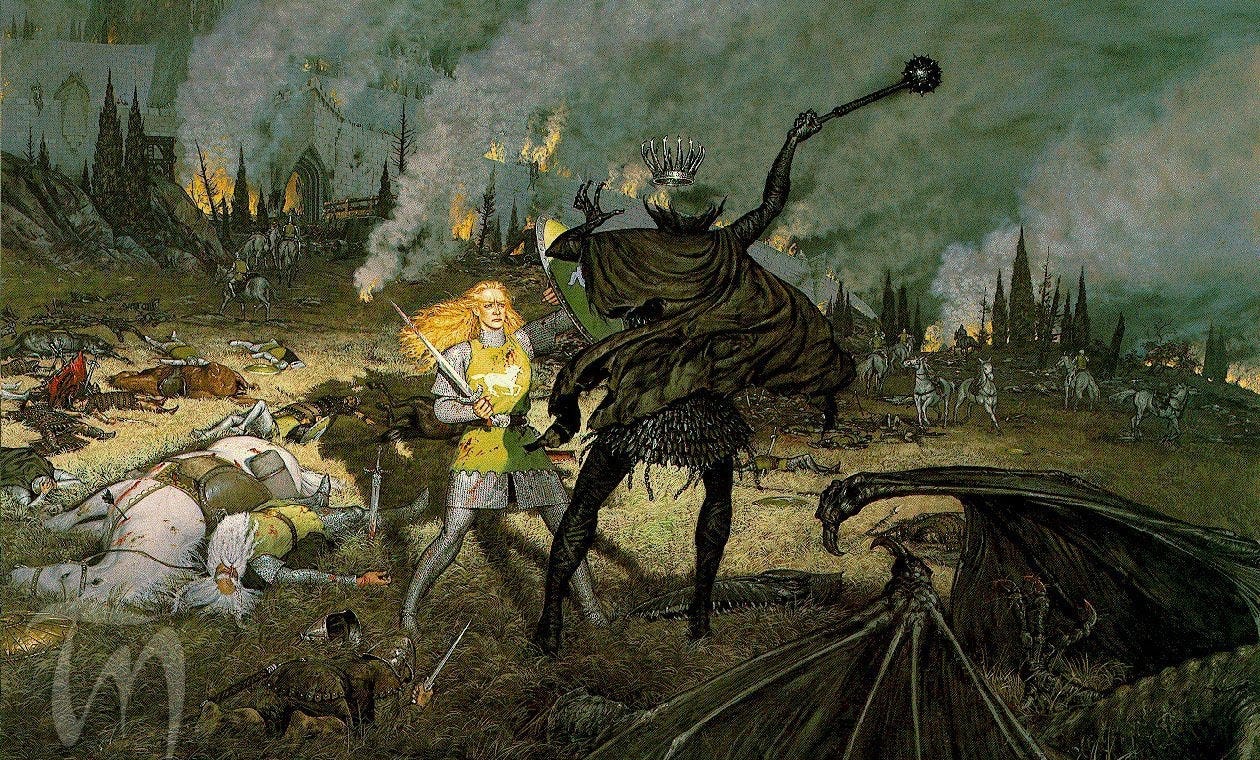
“In rode the Lord of the Nazgûl. A great black shape against the fires beyond he loomed up, grown to a vast menace of despair. In rode the Lord of the Nazgûl, under the archway that no enemy ever yet had passed, and all fled before his face.”
—Chapter 4, The Siege of Gondor
Éowyn, however, stands her ground—and advances to avenge a fallen Théoden. She slays the Black Rider’s beast, then fearlessly faces the feared. Her shield shatters when his mace connects; her arm breaks. She stumbles, and just when he is about to deliver the fatal blow, from behind comes Merry’s blade to tear through the villain’s knee.
And in the brief second that follows, Éowyn drives her sword between his crown and mantle. And down the Lord of the Nazgûl goes, never to threaten or stain Middle-earth with his existence again.
That’s something to sing about.
Hopelessness as wisdom, surrender as control
Denethor’s storyline is an exceedingly bleak one.
When introduced in the first chapter, Denethor, father to Boromir and Faramir, is painted as the formidable, strong-willed Steward of Gondor. He is said to possess great wisdom and “keener sight than lesser men” (p. 991); having long studied Sauron, he is to an extent able to see into the Enemy’s movements and intentions. The surviving city of Minas Tirith has been under his rule for generations, and it is largely his strength of mind that has kept it standing.
Watching him spiral was like witnessing a tower collapse.
I’m aware he’s not a popular character. But I like to think he deserves pity, not dislike. For Denethor, proud of his lineage and authority, is mercilessly tortured through them.
He rejects the possible extinction of his line and cannot tolerate the idea of being replaced. The King’s return would reduce him to a caretaker for another man’s glory. He wants that glory, however earned.
This anxiety has strained his relationship with Faramir. As the younger son, Faramir possesses a disposition that doesn’t entirely align with his father’s. Denethor sees him as too gentle, lacking his ideal of strength and defiance. Boromir, on the other hand, once embodied the perfect successor.
Their most important (and heartbreaking) exchange takes place after Faramir returns to inform his father of his doings in battle:
“My son, your father is old but not yet dotard. I can see and hear, as was my wont; and little of what you have half said or left unsaid is now hidden from me. I know the answer to many riddles. Alas, alas for Boromir!”
“If what I have done displeases you, my father,” said Faramir quietly, “I wish I had known your counsel before the burden of so weighty a judgement was thrust on me.”
“Would that have availed to change your judgement?” said Denethor. “You would still have done just so, I deem. I know you well. Ever your desire is to appear lordly and generous as a king of old, gracious, gentle. That may well befit one of high race, if he sits in power and peace. But in desperate hours gentleness may be repaid with death.”
“So be it,” said Faramir.
“So be it!” cried Denethor. “But not with your death only, Lord Faramir: with the death also of your father, and of all your people, whom it is your part to protect now that Boromir is gone.”
“Do you wish then,” said Faramir, “that our places had been exchanged?”
“Yes, I wish that indeed,” said Denethor. “For Boromir was loyal to me and no wizard’s pupil. He would have remembered his father’s need, and would not have squandered what fortune gave. He would have brought me a mighty gift [referring here to the Ring].”
[…]
“Comfort yourself!” said Gandalf. “In no case would Boromir have brought it to you. He is dead, and died well; may he sleep in peace! Yet you deceive yourself. He would have stretched out his hand to this thing, and taking it he would have fallen. He would have kept it for his own, and when he returned you would not have known your son.”
—Chapter 4, The Siege of Gondor
Denethor fails to recognize that the quality he prides himself on—his unwavering ambition—and which he passed down to his eldest, is his weakness. When he takes up a palantír, Sauron finds an opportunity to act on this weakness—to use that quality against him.
The strategy Sauron uses is an infallible psychological attack. The palantír shows Denethor nothing but the extent of the Enemy’s military power, as a preview of what awaits Minas Tirith. It’s a strategy that aims at despairing the Steward, at draining him of all hope for victory—or, at least, survival. What the palantír does is confirm his greatest fears: the unavoidable end of his lineage, of his authority, of all that still belongs to him. It renders the glory he seeks impossible.
And so Denethor resorts to hopelessness. By the time the battle on the Pelennor Fields begins, he has already decided that there is no saving Minas Tirith. He considers it wise to despair, and sees surrender as the very last taste he might have of agency: if he and his line are to die—and he has decided they will—then they are to die on his own terms. Faramir being gravely hurt during battle only encourages him to end it all there and then. Thus the pyre.
Threatening a man’s most prized quality to despair him into madness is an exceptional example of psychological warfare. Sauron took the great Denethor down without having so much as moved a finger.
Brilliant, yes. But Sauron may still be outsmarted.
The final stroke
In my analysis of Book Three, I reflected on how Sauron’s defeat, if it happens, will be largely self-inflicted. One reason I gave at the time is that Sauron does not think as his enemies, does not see beyond his own mindset.
“Sauron is an entity so consumed by ambition that it simply does not occur to him that someone would refuse to wield the Ring. In his mind, an item this powerful can only be desired; it is inconceivable that it should be destroyed of its bearer’s own volition. This makes him narrow-minded, causing him to rely on the false conviction that his enemy will act as he would himself.
Sauron is aware that a hobbit carries the Ring. He also knows that Minas Tirith is kept by stout rival men who would vanquish him should they come to bear it. He has thus dispatched his forces to that land instead of using them to guard his own, because if he were the Ring-bearing hobbit, equipping the mighty men of Minas Tirith with the Ring is what he would have done to win the war and seize the Dark throne. Indeed, Gandalf, the rest of the Company, and the Riders of Rohan are headed to Gondor’s capital—but to fight off those forces. The Ring heads East, to Mordor—something Sauron’s mind is unable to foresee. That, Gandalf says, is his weakness: projecting his own logic onto others.”
Following the victory on the Pelennor Fields, and the mess that is Denethor’s pyre death, the surviving leaders gather to discuss their next course of action. The strategy proposed by Gandalf sounds like a desperate, mindless act: to send the remaining troops toward the Black Gate of Mordor in one final stroke. Their numbers have dwindled, whereas Sauron’s persist on growing. Gandalf guarantees that victory is impossible and death the most likely fate for all those who go.
But victory isn’t the goal. Stalling is.
The wizard is perfectly aware of how the Enemy thinks. So here I’m willing to draw a parallel between Gandalf’s strategy and Sauron’s on Denethor: the former intends to use the Dark Lord’s mindset against him, just as the villain previously used Denethor’s to bring him down.
Sauron’s ambitious mind would have him think that Aragorn, announcing himself as the returned King of Gondor, is the current Ring-bearer. It would have him believe that the preceeding owner, the hobbit now trapped in his premises, had managed to deliver the Ring to Isildur’s heir prior to being captured. Sure, Aragorn’s army consists of very few in comparison—but with the Ring supposedly in his possession, these few men become unstoppable. The realization is meant to shift Sauron’s attention to the King and his group while the hobbit inside destroys the Ring.
But here’s the thing that most troubles me: Gandalf is acting on the assumption that Frodo and Sam have made it to Mordor. As readers, we know this is true; but he and the characters on his side have no certain knowledge of the hobbits’ whereabouts and doings during the making of this decision.
And yet the decision is made—and, truly, it is a shot in the dark. A gamble.
But their hope speaks louder than the odds.
By the time we reach the end of Book Five, however, the army’s spirit is crushed: for Sauron has not showed at the Black Gate, and his spokesperson has triumphantly displayed Frodo and Sam’s belongings (as found by the Orcs scouring Shelob’s lair). For the time being, Gandalf and his companions most likely believe the hobbits have fallen and all has been lost, and that the fight that ensues is to include their very last breaths.
I confess I have no idea what is bound to happen. A part of me wants Sam, as the new Ring-bearer, to head over to Mount Doom on his own and put an end to the army’s despair. But another part of me worries that if he does that first, it might become too late to save Frodo’s life from the hands of his captors.
Memorable quotes from Book Five
“And as for valour, that cannot be computed by stature.” —Gandalf
“The mightiest man may be slain by one arrow.” —Pippin
“The hasty stroke goes oft astray.” —Aragorn
“Where will wants not, a way opens.” —Dernhelm (Éowyn in disguise)
“It is all dark, but it is not all night.” —Ghân
“Need brooks no delay, yet late is better than never.” —Éomer
“Do not spoil the wonder with haste!” —Legolas
With Pippin I began this post, and with him I shall end it. The last we see of this hobbit is during the battle by the Black Gate. Believing he is required to perform a great deed, as Merry did on the Pelennor Fields, he insists on joining the fight—and finds himself being crushed by a troll.
It’s unclear whether he survives. The Book ends vaguely in this regard. But I wish him to make it out alive, for he has truly grown on me. I insist on dreaming of a scene in which all four hobbits are reunited, safe and cheerful, once all this is over. And they each shall have some glorious deed to boast of.
As for me—I shall now start reading Book Six. And although I’m fretting to discover what happens next, my heart aches, for soon I will no longer know what it’s like to read LOTR for the first time.
Until next time,
Heba
What are your thoughts on Book Five? I’d love to hear them:
Know a LOTR fan who might enjoy this? Feel free to share!
I've read LOTR many times and it's such a delight to see it through your fresh eyes. Looking forward to the next installment!
This was so much fun to read! I feel excitement for you as you speculate and anticipate. And your prose is beautiful. I am in awe!