
Random Fiction I'll Always Recommend (Vol. II)
Six more literary gems worth sharing

This post is preceded by:

Few experiences rival the delight of reading a good book, and wishing that delight upon someone is an act of affection.
In that sense, recommending a book is one of the most affectionate gestures we can make. It implies we know someone well enough to imagine the kinds of stories they might cherish. But more importantly, it suggests that we care enough to want for them the joy of discovering a work that may stay with them long after the last page.
While I cannot claim to know each of you well enough to predict what literature you will love, the fact that you spend time engaging with the ideas I write about tells me our tastes may not be too dissimilar.
And so, as a small expression of affection, I bring you the second volume of this series, hoping that somewhere among the titles below you will find your next favorite read.
Rec. #1: The Giver of Stars (2019)
Novel by Jojo Moyes
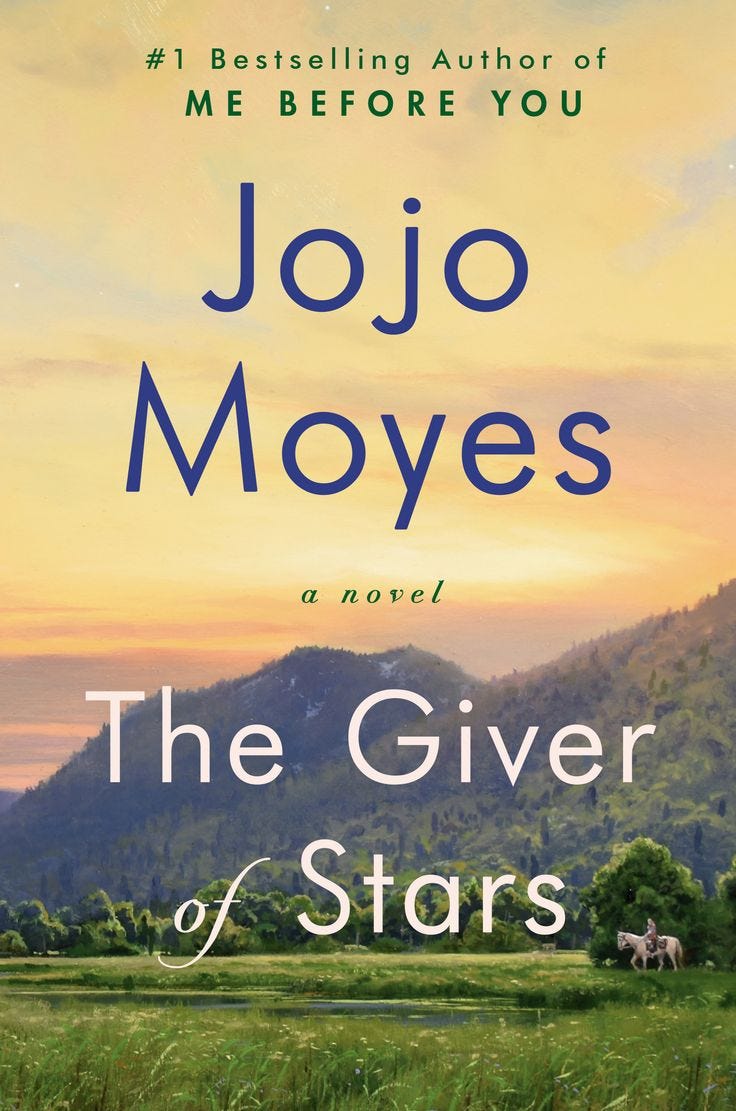
I recall hesitating to start this novel because I had the impression Jojo Moyes wrote, exclusively, contemporary romance—a genre I avoid. But my sister recommended it, and because her taste in literature is exquisite, I eventually set aside my preconceived prejudices and caved in.
To my delight I discovered that this 400-page novel was not a work of contemporary romance, but of historical fiction.
Set in 1930s Kentucky during the Great Depression, it follows Alice Wright, an Englishwoman who moves to the United States after marrying an American man. But not long after her move she finds herself trapped in an unhappy, restrictive life. She begins to seek a sense of purpose and independence, and finds it when she joins a group of women working for the Pack Horse Library Project.
Historically, the project was part of the social reforms launched by President Franklin D. Roosevelt during the New Deal era (1933-1939). For the women involved, it meant delivering books to isolated mountain communities on horseback. Trails could be dangerous, especially in unfit weather, but these women ensured that people who had no way to access libraries could have literature brought home to them.
I remember feeling quite intrigued by the Pack Horse Library Project and spending several days afterwards reading on the topic of mobile libraries (commonly referred to as bookmobiles), sifting through the different, unconventional ways books have been dealt and distributed across history. It was rather comforting seeing to what great, uncomfortable lengths people have gone to make reading possible for everyone.
Alice and the other librarians thus travel through difficult terrain on a mission to bring stories and education to these underserved people. On the way, they form deep friendships and challenge the social expectations placed on women. The novel explores themes of literacy, female solidarity, freedom, class, and above all, the transformative power of literature, while also weaving in some romance and small-town tensions.
In other words, this book reads like a love letter to literature—and feels like a warm hug.
Rec. #2: One Hundred Names (2012)
Novel by Cecelia Ahern
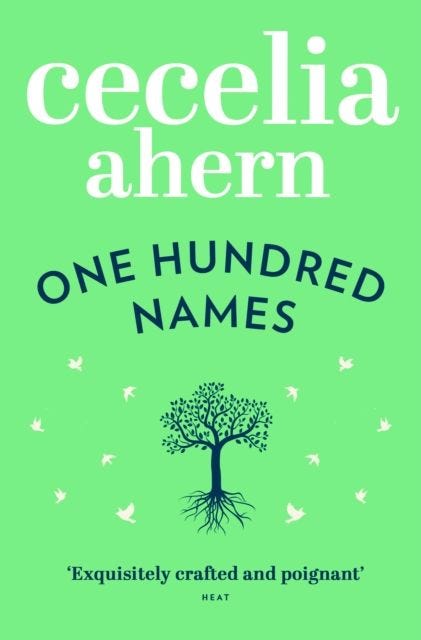
I would likely never have come upon Cecelia Ahern if it had not been for (yet again!) my sister. Gentle, unhurried prose, and stories gentler still—the author writes on the complexities of emotion, revolving her craft around the fragility and sacredness of human connection.
One Hundred Names was my introduction to her work. It centers Kitty Logan, a journalist whose career and reputation are damaged after she publishes a false, defamatory story. Struggling to rebuild her life, she is given an unusual assignment linked to her late mentor, Constance.
A mysterious list containing one hundred names, with no explanation attached.
Kitty begins to investigate the names, and what first seems like an assortment of irrelevant people gradually becomes a series of interconnected stories. Love, loss, resilience, hidden struggles—she listens as these strangers revisit their pasts, confiding in her their deepest sorrows and greatest joys. One by one, these encounters (re)awaken Kitty’s empathy and allow her to pave a path toward her own redemption.
A tale on the very human tendency to err and to regret, on second chances, and on the unseen influence people have on each other.
Rec. #3: Waiting for Godot (1953)
Play by Samuel Beckett
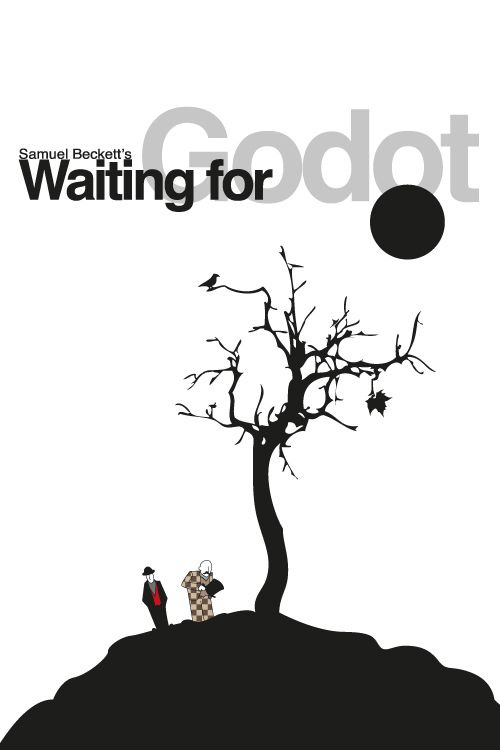
Fittingly, I have somewhat of an absurd history with Beckett’s Waiting for Godot, to the point that it has become the subject of inside jokes between me and a couple of friends, and the story behind one of my nicknames.
The play was required reading for a unit on absurdist literature in my undergrad days—a genre which, unlike the aforementioned inside jokes, bears an undeniable bleakness, even if it does hide behind humor. Absurdism explores the supposed meaninglessness of human existence, emphasizing the conflict between our constant desire for purpose and a universe that offers none. It tends to depict characters in bizarre or irrational situations, responding to chaos with cynicism or confusion.
Beckett is famously known as the master of the ‘theater of the absurd,’ and Godot contains much of its defining qualities: an illogical plot, (arguably) meaningless behavior, dark humor, and nihilistic protagonists. It centers two men, Vladimir and Estragon, who wait by a tree for someone named Godot—who never arrives. As the wait drags, they engage in repetitive conversations and arguments (which are mostly incoherent), offering reflections on life, memory, suffering, and hope.
So puzzled was I by the text the first time I read it that, a week later, I still did not know what to make of it. But then I realized that this effect is precisely the objective of absurdist literature: to leave us searching for meaning in the text just as we tend to scramble for meaning in our existence.
Waiting for Godot is thus a must-read for those seeking to have their perfectly sensible world challenged.
Rec. #4: Trifles (1916)
Play by Susan Glaspell
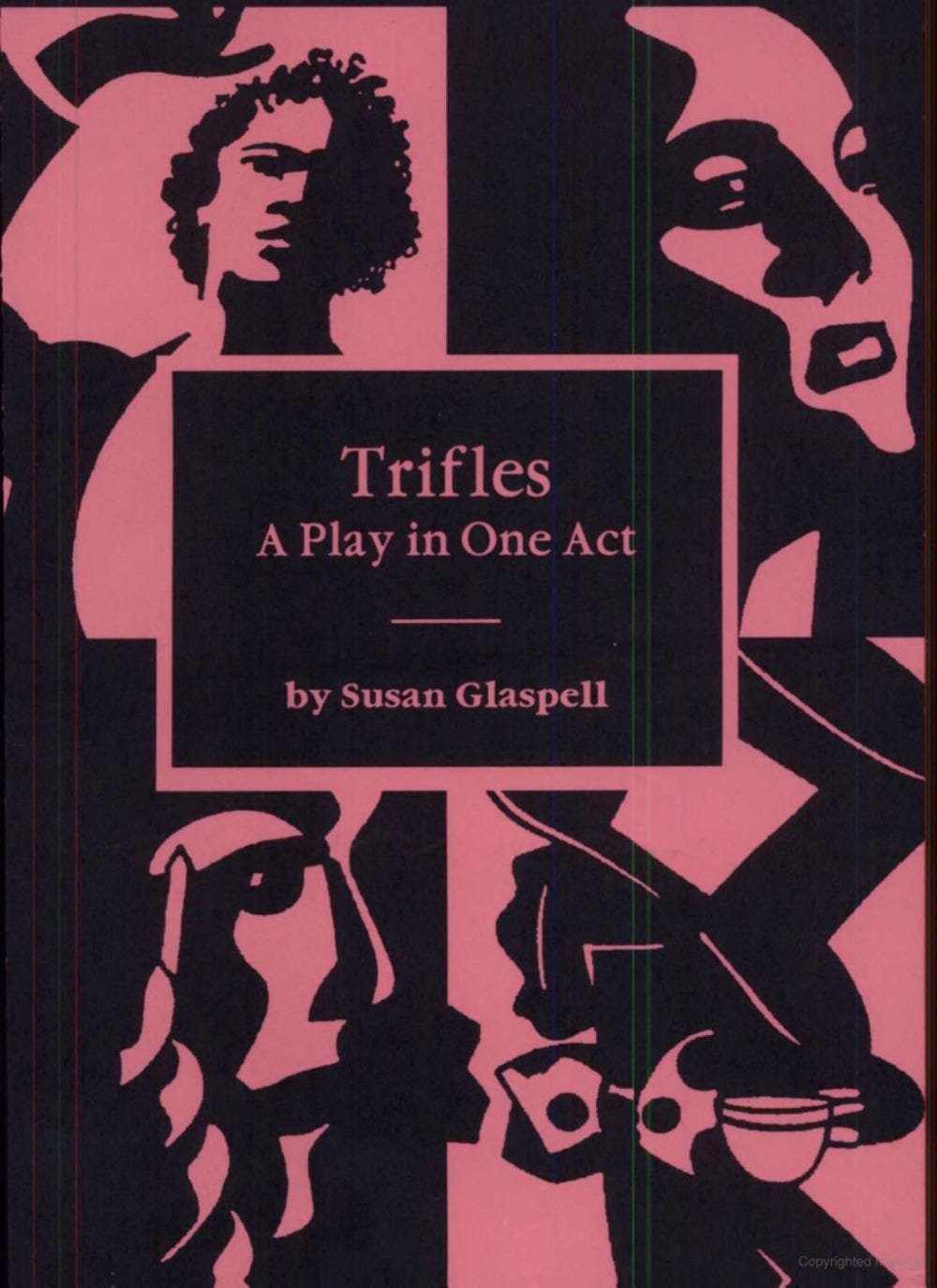
If there’s anything I love as dearly as detective novels, it’s detective plays.
But Trifles is more than a satisfying whodunit. In just one act, it weaves into the central mystery powerful commentary on the casual dismissal of women’s experiences and capabilities.
When a man named John Wright is found dead in his rural farmhouse, authorities begin to investigate the area for evidence of murder. Neighbors, all women, stay behind in the kitchen—where they start noticing small domestic details they suggest the men inspect. The men, however, undermine such discoveries and consider them mere ‘women’s trifles.’
In reality, these discoveries reveal the emotional abuse and loneliness suffered by John’s wife, Minnie.
As the women piece together clues hidden within the household objects, they come to understand a possible motive for the crime and suspect Minnie as its perpetrator.
It’s awfully entertaining to watch the men struggle with the case while the women have it figured out so easily, thanks to sheer female solidarity. But above all else, the play is an eye-opening critique of marital neglect and emotional deprivation—a fitting read if you’re looking for a short but socially loaded mystery.
Rec. #5: A Rose for Emily (1930)
Short story by William Faulkner
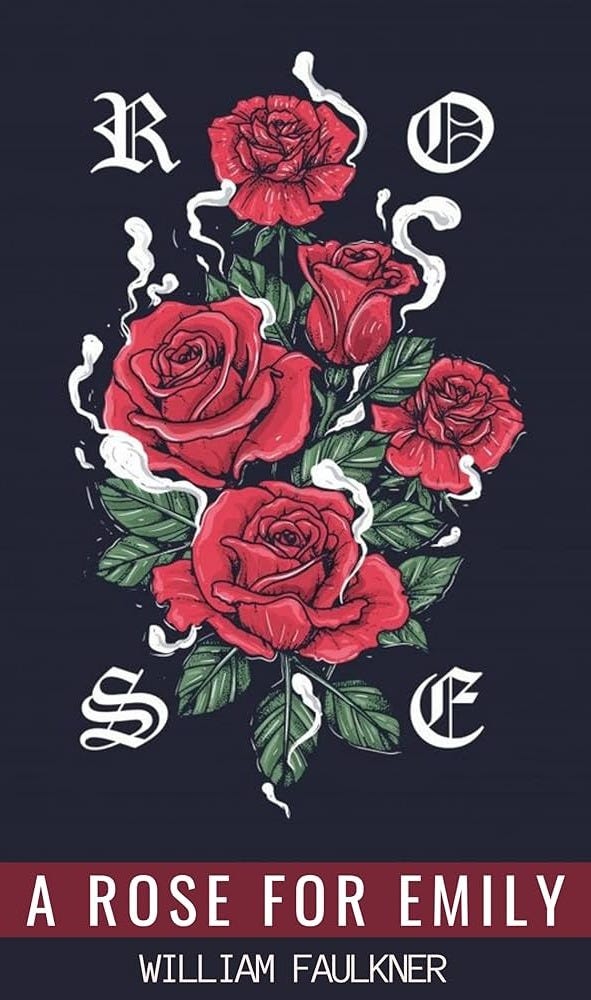
Southern Gothic. An ethically dubious protagonist. A display of moral (and literal) decay.
Faulkner’s tale is about Emily Grierson, a reclusive woman from a small Mississippi town. It opens at her funeral, which the townspeople attend partly out of respect and partly out of curiosity, since Emily has become a mysterious figure who has lived in near-total isolation for years. They narrate her story in a non-linear manner, moving back and forth through different periods of her life, gradually revealing an unsettling truth about her final days—a plot twist I think about often.
One of the first facts told of Emily is that she comes from a once-prominent Southern family. Her father was domineering and drove away suitors, leaving her unmarried and dependent upon him. When he dies, she struggles with feelings of loss and refuses to accept his fate, keeping his body in the house for several days before the authorities are left with no choice but to intervene.
As the town begins to modernize, Emily remains a symbol of old Southern aristocracy. She stubbornly resists the changes happening around her, even refusing to pay the new taxes.
For years, she remains rather forgotten, but talk of her resurfaces when she becomes romantically involved with Homer Barron, a Northern laborer overseeing a construction project in her town. The townspeople gossip about the relationship because Homer is socially beneath her and seemingly uninterested in marriage.
When he disappears one day, Emily withdraws from public life once again—until the end of her days.
A Rose for Emily is an eerie exploration of Emily’s inability to cope with loss and change. It is a story about obsession, denial, and the destructive consequences of living in memory rather than reality—and it was the very first work of fiction I read for my English literature degree. For a program that later introduced me to many literary gems, I’d say this was the perfect introduction.
Rec. #6: The Doll Queen (1964)
Short story by Carlos Fuentes

I hadn’t heard of Fuentes before being required to read this short story for class two years ago, and I regret not having picked up more of his work since then—because The Doll Queen was a phenomenal start.
It follows a protagonist named Carlos (which makes me wonder if the tale has any autobiographical foundations) who revisits an encounter from his childhood that has evolved into a lifelong obsession.
As a boy, he meets a girl named Amilamia in a park. She is physically disabled and spends most of her time sitting and talking with him. Their friendship is brief but intense; during their conversations, Amilamia tells him he is special to her and hands him a piece of paper containing her name and address. In Carlos’s imagination, she becomes an idealized figure: a beautiful, mysterious, magical “doll queen.”
Over the years, Carlos doesn’t forget her. Although their actual relationship was short and based largely on childhood fantasy, he transforms the memory into something larger. Amilamia becomes symbolic of innocence, first love, beauty, and an elusive, lost possibility.
As an adult, Carlos discovers the old paper with her address and decides to search for her—a search motivated by nostalgia and the unruly desire to reconnect with the perfect memory he has carried for years.
But upon reaching her address, reality begins to undermine his fantasy. And once led into the room where he expects to find Amilamia, he stumbles on a horrifying truth.
The story is powerful precisely because, through the gradual destruction of Carlos’s fantasy, it forces us to confront the uncomfortable contrast between childhood imagination and adult reality.
It is, in other words, a reminder of all the things we have been disillusioned by since we ceased being children.
If nothing else, this list (and others I shall bring your way) reminds us of how beautifully diverse literature, and someone’s taste in it, can be. A historical novel about horseback librarians, an absurdist play about waiting, a Southern Gothic tale of obsession, a mystery hidden in domestic spaces—there is no shortage of worlds to enter and ideas to wrestle with.
And if even one of these recommendations finds a place on your bookshelf, then this small gesture of literary affection will have served its purpose.
Until next time, and happy reading,
Heba
Have you read any of those recommended titles? If yes, I’d love to hear your thoughts!
Know a reader who might enjoy this?
I've been thinking of the same too. Till now I have unpublished drafts in drive waiting to see the light. Unfortunately, I don't have Instagram, but this seems like a good reason to make an account!
I'm only familiar with a rose for Emily and reading this felt like receiving a rose. 🌹 Hehe.
Two things:
- What's your nickname? 🙊
- Fatima should start a Substack! 🌟
Okay, jokes aside — this was a wonderful read and a very diverse one indeed
Is there a genre of litritutre that explores meaning in a more optimistic lense? Any recommendations regarding that?
I remember you mentioning in a Substack that you'd give the crown to The Chronicles of Narnia in terms of intricit world-building (I am paraphrasing from my memory to the best of my ability).
Novels like this tend to leave me with a trancedent feeling about life.
Thank you for writing this Heba! ☺️