
Presenting 'The Notebook Spotlight': Episode I, Artefactum Journal
From her quiet home in Berlin, a young woman writes about books—and turns her thoughts into art

In July, I was delighted by how well one of my articles was received. The Rise of Youth-Led Lit Mags started only as a list of available opportunities for young creatives; I had seen a few new magazines make submission calls and thought my subscribers would appreciate being informed. But a deeper search on Instagram showed me there weren’t, in fact, a few. There were dozens. Teenagers and young adults around the world were taking on the responsibility of leading and maintaining a literary magazine, expecting neither profit nor virality.
What I was seeing wasn’t a coincidence. The “chronically online” generation was every bit intentional in making space for serious art and writing on platforms often criticized for their frivolity.
Thus I expanded the article to reflect on the significance of this phenomenon—this refreshing, comforting phenomenon. I happily found that it’s touched others as it has me. In case you haven’t yet, you can read and join the discussion on the post below:

What has since stuck with me is the knowledge that all about us there are people actively trying to make art a part of their own and others’ lives. They grapple with crammed schedules and unrelenting distractions, slipping away to create something remarkable. Like the youths behind magazines, they are on a mission to instill beauty and depth into an otherwise hollow day-to-day reality.
I’ve decided I want to know these people.
It is a pleasure to inaugurate The Notebook Spotlight, a segment that aims to celebrate a variety of community-based initiatives. Each episode will consist of a conversation with the individual(s) spearheading the project, exploring its motive, scope, and impact. In the spirit of The Humanities Notebook, such project can be:
Literary i.e. work that seeks to nurture a love for reading and writing in the surrounding community (think: children’s reading programs, in-person and online book clubs, small indie bookstores, supportive writing circles…).
Artistic i.e. efforts to foster an appreciation of artistic expression in its various forms (think: accessible art courses and workshops, community theaters, open studios…).
Educational i.e. programs to incentivize humanities-focused learning (think: community museums, literacy and language-learning courses, philosophy cafés, public forums…).
In a nutshell, the purpose behind The Notebook Spotlight is to give space to the voices trying to make positive change in their societies—no matter how small they may be—and to expose my subscribers to something beautiful to which they can contribute or offer support.
For the first few episodes, the initiatives will be handpicked by yours truly. However, if you are familiar with a project you think deserves a shout-out, feel free to make a suggestion! Once this segment takes off, I will be receiving applications on a rolling basis (we’ll touch more on this in a future post).
For now, welcome to this segment and enjoy its debut episode:
📝Episode I: Artefactum Journal
I am excited to share a conversation with a very special individual. She may be, first and foremost, my sister, but today I’m happy to focus on her endeavors as a fellow bibliophile and creative.
In late July, Fatima El Hallak launched Artefactum Journal—a cozy nook on Instagram she’s dedicated to sharing her passion for both literature and design. But soon her content went beyond her quiet home in Berlin, and Artefactum has become her means to not only document that passion, but also to engage with those in her community sharing in on it.
Let’s find out what Artefactum is all about! 📚
H: Hello, Fatima, and welcome to The Notebook Spotlight. I’m delighted to have you as my first guest! Why don’t we start this off with a brief self-introduction? Can you tell us a bit about what drew you into literature in the first place?
F: Hello everyone! Thank you for inviting me to be part of The Notebook Spotlight. I’m Fatima, 27, Lebanese-Brazilian, and currently living in Germany. I’m the face behind @artefactum.journal, an Instagram space dedicated to books—where I translate my readings and reflections into colors, shapes, and textures.
My love for books goes all the way back to childhood, ever since I first learned to read and write. I remember diving into the stories from my Arabic schoolbooks before classes even started (we usually bought them during summer vacation) and collecting little Arabic storybooks—nostalgic treasures for every ’90s Arab kid. At the same time, Brazilian comics like Turma da Mônica were also a big part of my childhood. I can still recall recesses when I preferred reading them over playing. That’s really where my curiosity for the literary world began.
As I grew up, the types of books I read shifted with each phase of life, and I can almost always tie a title to a moment in time: Um Girassol na Janela by Ganymedes José at nine, James and the Giant Peach by Roald Dahl around twelve, the Harry Potter series at fifteen, Les Misérables (in Arabic!) at sixteen, and then my Agatha Christie phase at sixteen–seventeen. To this day, I still enjoy picking up one of her mysteries. They remind me of those times when I could devour a whole book in one sitting.
Looking back, what has always drawn me to reading is the way stories allow us to explore different realities, cultures, and perspectives—all from the comfort of home. It fascinates me how my mind paints vivid pictures while I read, as if I were watching a film, and how that image is unique to each reader. In the end, I’d say what attracts me most to literature is its power of escapism and its ability to nurture empathy within us.
The short stories I collected as a kid!
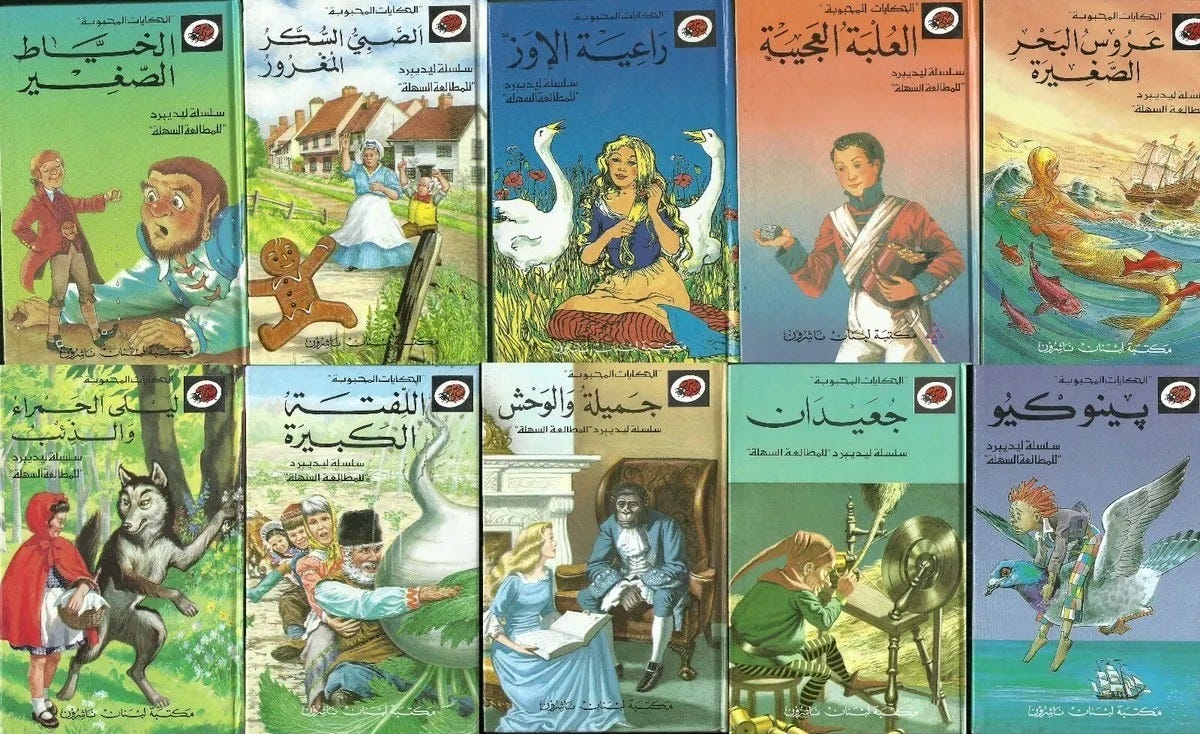
H: I remember seeing these storybooks around! I think I’ve read the Little Red Riding Hood and Gingerbread Bread Man ones. Good times.
Now, I’m curious: Artefactum is a Latin term meaning “made by skill” or “made by art.” How does it relate to your project, and how did you come to choose this name in particular?
F: Another love of mine as a child was art. I loved to paint and used to say that one day I’d become a painter. Well, that didn’t happen. Unlike reading, that passion faded as I grew older, and I ended up pursuing the scientific side of my studies, becoming a medical lab technician. But I never truly found myself there. Eventually, I decided to change careers and was drawn to design, which allowed me to reconnect with that artistic side I had left behind. Today I work as a UX/UI designer—a field that beautifully blends tech, design, and even a bit of science. Still, I hope to move more toward visual design in the future, to explore creativity further and do purposeful work through it.
When I began thinking of Artefactum, I asked myself: why not bring both my passions together? Books have always been my constant, and design can become the way to express what I read and reflect upon—through colors, textures, and visual storytelling. I also wanted to build a community of fellow book lovers, a safe space where we could share our readings while I continued to grow my artistic skills. That’s when the name came to me. Artefactum—“made by art, made by skill”—felt like the perfect representation of this initiative: a weaving of literature and design, crafted with intention.
H: What is the purpose behind Artefactum, and how would you say it stands out from other Bookstagrams?
F: The purpose behind Artefactum is to create a close-knit community of readers—a space where we can exchange our literary experiences, reflections, and bookish opinions. I like to think of it as a give-and-take: from my side, I share my readings visually, interpreting them through design as best as my skills allow; from my followers’ side, they share their thoughts, reactions, and recommendations. Together, it becomes a dialogue. A safe place to connect through books.
What makes Artefactum stand out is the sensory approach I try to bring into my posts, along with a commitment to authenticity and transparency. My content is shaped by how I personally experience literature—how a story feels, how I imagine it, and how I want to translate that into colors, textures, and visuals. It’s not about following trends or posting what’s popular at the moment, unless it truly resonates with me and my purpose. For me, it’s more meaningful to have fifty followers who feel like friends, who genuinely connect with the stories I share, than thousands without that sense of real exchange.
Artefactum is, in many ways, a work in progress. My posts may not always look “perfectly polished,” but they carry my imprint. Over time, I hope to see how my way of expressing literature evolves, and more importantly, how it might leave a positive mark on others along the way.
H: Let’s talk preferences: does Artefactum focus on certain genres, authors, or periods—or do you prefer to keep it eclectic?
F: For me, it always comes back to authenticity; I’ll only share what I’m truly enjoying. Over the past few years, my reading choices have been fairly steady. Genre-wise, I’m especially drawn to historical fiction, murder mysteries, and what’s often categorized as romance—but I prefer to think of it as the “lifey” genre. These are the stories that dive into a character’s life, a pivotal moment, and how it unfolds. They may include romance, but it’s not the sole focus. I’m not much into chick-lit style reads that feel overly superficial, though I do enjoy something lighter now and then—especially between heavier books—as long as it carries some depth. I also enjoy dystopian fiction, and lately, classics have been taking up more space on my TBR.
When it comes to authors, I love discovering new voices and exploring fresh perspectives, but I also have my comfort reads. For years, Agatha Christie and Elif Shafak were my go-to choices whenever I wasn’t sure what to pick up next, and they still hold that place for me—alongside Cecilia Ahern now. As for periods, I don’t focus on a specific era; I choose more by genre and synopsis. At the end of the day, Artefactum will always reflect the books I genuinely connect with—whether they’re classics, contemporary, or something unexpected.
H: How has your multicultural background shaped your reading habits, and does your experience change depending on the language you’re reading in?
F: Even though I grew up with two mother tongues, the reality is that I read mostly in English. That’s something I’m working on, because I would really love to include more works in my native languages—especially Arabic.
Being multicultural has definitely shaped my reading habits. I think it has given me empathy and patience. Moving between countries and cultures as a child taught me how to adjust to new environments, customs, and languages. That sparked a curiosity in me to explore stories different from my own, to understand other perspectives quietly and deeply. Patience came from the challenges of change—new schools, new friends, new languages—and I find that reflected in how I read. For example, I genuinely enjoy slower-paced books because I appreciate the way authors build characters and worlds over time. A story doesn’t need to be fast-paced to be rich in detail and depth.
As for language, the core of reading feels the same no matter what I’m holding in my hands: I build images in my mind and feel emotions unfold with the narrative. But each language adds its own nuance. Arabic carries a kind of lyrical magic—rich in wording and composition, almost poetic, though sometimes more challenging. Portuguese brings a sense of freshness and warmth. And English, for me, feels comfortable, like home in its own way.
H: I agree with your point on language. Though stylistics differ, the essence of the reading experience remains a constant across languages and cultures. It’s something that reminds us of the universality of storytelling, and I think it’s beautiful.
I’d like to focus now on the intersection of design and literature that is at the center of Artefactum. How do you hope to further explore this intersection? For example, do you plan to experiment with cover design at some point? (as a big fan of your style, I’d recommend that you do!)
F: I’d say I’m still very much in the exploration phase with Artefactum—and in a way, I think I always will be. Part of the joy is experimenting with new ways to express my readings and the emotions that come with them. As my skills grow and evolve, I hope to discover fresh ways of blending design and literature even more seamlessly.
Right now, I have some recurring content formats that shape my work: deep-dive reviews (thoughtful explorations of books that truly touched me, combining insights, colors, and mood), book series recommendations (curated series picks for readers looking to explore new worlds), favorite quotes (visually styled snippets meant to spark reflection), cover crush (spotlighting impactful cover designs), and shorter reviews for reads that don’t make it into the deep-dive format but are still worth sharing. Beyond these, I like to experiment with special content whenever inspiration strikes.
In the future, I’d love to take the design side further—maybe by reimagining book covers, creating book-inspired posters, or even bookmarks. Ultimately, it would be a dream to see my design work connected more directly to the book industry. But for now, I’m enjoying the process of growing, experimenting, and sharing that journey with the Artefactum community.
H: One of my favorite things about this project is your placement of Artefactum stickers in the streets of Berlin. I like that it frames the love for books as something public—as something that ought to be discovered by every passerby. When you started the page, did you have a particular audience in mind, or was it intended to be accessible by all?
F: Artefactum is for anyone who enjoys reading—or wants to start exploring the world of books—and likes to talk about it. No matter where you come from, your age, or what you enjoy reading, this is a safe space to experience that. It’s also for anyone looking for a bit of inspiration, whether through the books, quotes, or designs I share.
The sticker campaign is especially dear to me because it’s meant to feel cozy, approachable, slightly mysterious—much like Artefactum itself. It represents a passionate reader who is exploring the design world, sharing their reflections while letting the books take center stage. I chose not to show my face publicly in Artefactum to maintain this sense of mystery, to focus attention on the books themselves, and also for personal safety when sharing content with the wider world. It’s a little playful, a little secretive, and entirely in the spirit of discovering stories—both in books and in the streets.


H: I’ve enjoyed the reel in which you visit three of your favorite bookshops in Berlin. In what other ways do you plan for Artefactum to interact with the literary community around you (and/or around the world)?
F: I really enjoyed putting together that reel, though I have to admit I’m a bit camera-shy and still figuring out video editing. Hopefully, that will improve with practice! I plan to create more reels sharing experiences and bookish content, so keep an eye out—there are some fun ideas lined up for the next few months.
I’ve also been inspired by other bookstagrams that host Zoom calls to discuss current reads or run online book clubs. I love that idea and would really like to do something similar, adding a little Artefactum twist. For now, I’m waiting to grow a tighter community of bookworms here on Artefactum, so when the time comes, we can have an online book club or interactive sessions in a format that truly fits our community and carries the Artefactum spirit.
H: What have been the most rewarding and most challenging aspects to running Artefactum so far?
F: The most rewarding part of running Artefactum is seeing my vision come to life. I truly enjoy creating content—thinking of creative ways to translate my reading experiences into visual storytelling—and I cherish how each piece turns out. What warms my heart the most, though, is seeing people interact and share their thoughts. Watching the community come together, even gradually, is incredibly fulfilling.
At the same time, that sense of community is also what makes it challenging. My goal with Artefactum isn’t to grow a massive follower base or go viral; it’s not a business (though I might be open to possibilities in the future). Instead, I want to nurture a well-knit, interactive community, and building that slowly has proven to be a challenge. Video editing is another area I’m still learning, and continually improving my design skills is both motivating and, at times, an obstacle—but I enjoy the process and the growth it brings. Despite the challenges, every interaction, every shared thought, and every small moment of connection reminds me why I love building Artefactum, and keeps me excited for what’s ahead.
H: We’re all readers and we all hate spoilers, yet we’d love a sneak peek! What’s next for Artefactum?
F: You can definitely expect lots of bookish reviews, more content from Artefactum’s segments (like deep-dive reviews and cover crush), and even some creative experiments that aren’t strictly bookish but still closely tied to this world—so keep an eye out. Along with the ideas I’ve shared throughout this interview, I also hope our community keeps growing so that more interactive, communal content can come your way—with Artefactum’s artsy, literary, and heartfelt flair. Thank you so much for giving me the space to share this project I truly cherish; my wish is to keep nurturing it as a warm, creative corner where people from all over the world can connect through their love for stories.
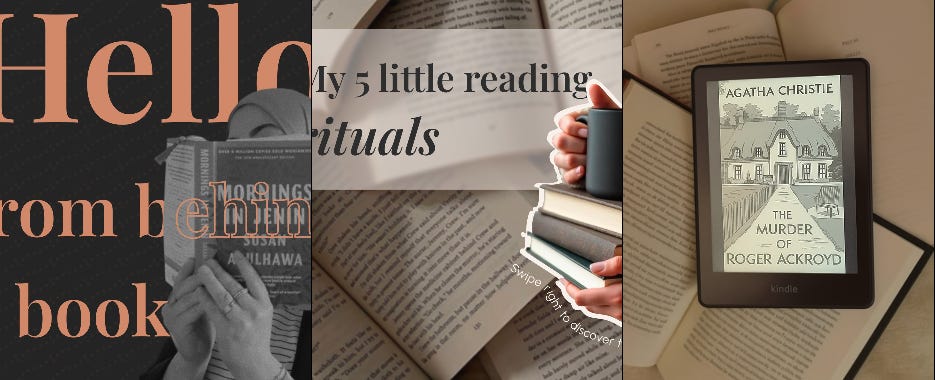
Artefactum may be in its early stages, but it’s already captivated an audience I wish to see grow more and more with each post. Make sure to follow @artefactum.journal on Instagram to support Fatima’s work and engage meaningfully with her content!
That’s a wrap for Episode I. Stay tuned for the second one in November 📅
Until next time,
Heba
Know someone who might enjoy Artefactum? Share this post with them:
Great read, love you