
How I Learn New Words
A three-step method for making words stick

Language is one of those everyday things that tend to be undervalued.
We think we ought to be poets to appreciate its aesthetics, and linguists to understand its intricacies. But language was made for the common man. It has evolved and expanded and branched out over centuries to serve his diverse expressive needs, from raising God’s praises to fraternizing with fellow creation, to wooing a lover, to storytelling and recitation; and yet, many a common man presently uses it as though mere practicality is all it has to offer.
But it has so much more to offer. Pronunciation that is to the ear what sunshine is to skin; spelling rules and conventions that’ll make you question whether their legislators had been sane; and etymologies that’ll leave you in awe—because human language, despite its uncountable variations across time and continents, remains one beautifully interconnected mesh.
Expanding your vocabulary is one of the ways to not only use but also treasure your language and all that which it can do. To bring out (and eventually make routine) its beauty and imaginativeness—both things this decolorized world has buried in its persistent championing of speech that is concise, direct, and efficient. Not to say lifeless.
It’s true that eloquence is less about the size of one’s vocabulary and more about the ability to communicate ideas clearly. Being lexically well-endowed, however, can be a major ego boost—but not because it helps you sound smart.
I don’t think vocabulary is necessarily a testament to intellect. Rather, it is a reflection of intellectual pursuits; a subtle revelation of what your brain consumes and cultivates. The readings you do, the voices you listen to, the viewpoints you choose to adopt.
If having a broad and colorful vocabulary thus paints us as the restlessly curious philomaths we aspire to be, then that is an endeavor to set out on right away.
For a long while, I thought learning new words was a passive activity. That once a word is encountered enough times in writing or speech, it will start seeping naturally into my own.
But in my case repetition in and of itself has not been all that successful. When I sit down to write, or engage in a conversation, recently learned words begin to elude me. My mind instinctively reaches out for what I call my “default words,” i.e., words I can safely use and overuse because there is no forgetting what they mean and in what contexts they can be said. Why don’t the new words occur to me as easily when I need them?
It has dawned on me that, through mere repetition, I am not learning vocabulary. I am consuming it. My approach needs to change.
After careful research and a few rounds of trial-and-error, I have designed a three-step process that is bound to facilitate my learning of new words—and ensure that they stick. Repetition is still the basis, but it is now of a strategic kind, revolving around two questions:
→ Which words should I begin with? and
→ In what ways should I be repeating them to myself?
I should probably acknowledge that the following technique may not work for you as well as it has for me. Indeed you may tweak some of its aspects to fit your accustomed learning style. But so long as this guides you somehow down the shifty path that is vocabulary learning, I shall feel that I have done my part.

Step #1: Choose the words you are phonetically attracted to
I was recently reading J.R.R. Tolkien’s A Secret Vice, a 1931 essay in which he discusses the art of constructing invented languages (an art otherwise known as conlanguaging). He describes it as the intellectual’s guilty pleasure, a private passion for those “savourers of linguistic flavours” (p. 5); i.e., for those enamored by the aesthetics of everyday language, those able to see and hear beauty in ordinary word-forms, so much that they are willing to strive in the creation of their own. It’s an undertaking that demands significant mental labor and consumes years of one’s lifetime—but which remains utterly and forever a source of pleasure.
A particular line caught my attention.
“It is an attenuated emotion, but may be very piercing—this construction of sounds to give pleasure. The human phonetic system is a small-ranged instrument (compared with music as it has now become); yet it is an instrument, and a delicate one.” (p. 21)
Humans are capable of producing around 800 distinct sounds (or phonemes): roughly 600 consonants and 200 vowels, distributed across all global languages. Of these, English uses about 44.
Tolkien asks us to think of these as 44 notes on an instrument. But when mere phonemes become music, we must eventually consider the question of taste.
Which speech sounds are pleasurable, and which aren’t?
Indeed, phonetic taste is as unique to each of us as our fingerprints. It is, argues Tolkien, what primarily guides conlanguaging: the language-inventor, on instinct, incorporates into his alphabets (and subsequent phonologies) the sounds and combinations that most please him.
And I think it should similarly be the basis for vocabulary learning.
When wanting to study new words, don’t go for the ones you think are important or intelligent. Don’t go for what everyone else is learning. Instead, choose the words you are sonically attracted to.
Upon encountering a new word you ought to repeat it several times—aloud. Get a feel for it. Notice whether you enjoy its rhythm. If the pronunciation is to your liking, add it to your list. The repetition strengthens your phonological memory, on the one hand; and developing an emotional or aesthetic attachment to it improves recall, on the other.
I personally am attracted to words that are vowel-rich, with open syllables and soft consonants. Words that feel fluid, unhurried, flowing. Examples include salient, aerial, serene, and dubious. As for consonants, I’m drawn to words that combine soft fricatives like /f/ with glides like /y/, especially in two- and three-syllable forms. Think futile, fusion, and refute. They sound light and breathy, and therefore pleasant.
Let this be your starting point. Explore your phonetic taste, and let the learning be driven first by sound, then meaning, then spelling.
Step #2: Make the words personal
With your taste discovered and your words selected, we move on to ensure they become easy to remember. The reason we tend to forget new words is often that we learn them in abstract definitions rather than meaningful situations.
And what could be more meaningful than that which is personal?
Psychologists have introduced the self-reference effect as “the tendency for people to better remember information when it has been encoded in reference to the self.” (Serbun et al, 2012). In other words, when new information is associated with personal memories, personality traits, or the concept of the self, the brain absorbs it more readily and organizes it more efficiently, leading to far superior retrieval at a later time.
To apply this to vocabulary, the trick is to attach each new word to your own life. Make up a sentence in which that word helps describe an experience, trait, or habit of yours. Then make it that word’s slogan.
Let’s take a word from my list. Salient. Cambridge Dictionary defines it as “the most noticeable or important quality or fact about something.”
The customized sentence I have made for it is:
“The salient feature in my bedroom is the five foot tall teddy bear sitting in the corner.”
It’s memorable to me because my bedroom is where I spend a great deal of time. It’s my most intimate space, and any sentence describing or mentioning it should be easy to recall. This slogan makes it so that every time I think of my room, or am prompted to think of something large and noticeable, I remember the teddy bear and, by extension, the word salient.
Step #3: Associate the words with imagery
The next move is to create a non-linguistic connection to the words. It engages what cognitive psychology calls the dual coding theory—the storing of information using two distinct but interrelated systems: one verbal and the other non-verbal.
When it comes to vocabulary, you would be storing definitions and word usage examples within the former system; for the latter, pictures and spatial representations. This way, instead of one weak memory, you would have two pathways for recall.
Take lugubrious as an instance. Your brain might not always associate this rather funny-sounding word with its definition—“sad and mournful” (Cambridge Dictionary). But if at the time of learning you attach to it a visual scene of, say, a gloomy Victorian figure slowly walking through rain, your brain finds a second pathway through which to conjure up a guess.
But those who do not identify as visual learners can replace pictures and illustrations with another kind of stimulant—a sound, sensation, or emotion. Lugubrious might not inspire a scene for them, but might cause them to hear, in their mind’s ear, a sorrowful cry; or trigger a distressing memory from days past.
Once these steps are completed, you will have created for every new word three signals to remember it by: one auditory (and simultaneously aesthetic) in nature, one relational, and one non-verbal.
I strongly recommend that you compile these signals in a word journal—an analog or digital notebook to which you can enter the words you are planning to learn. Below is the first entry in my own journal (which I created via Google Docs and converted into a PDF document). The words I’m phonetically attracted to are listed on separate pages, and for each is the shortest possible definition, the personal sentence (slogan) I have created for it, along with a picture that helps me envision it. Seeing that my artistic skills are questionable, I have resorted to Pinterest to find the visual cues. In the case of salient, I could think of no more fitting representation than that of an elephant in a room.
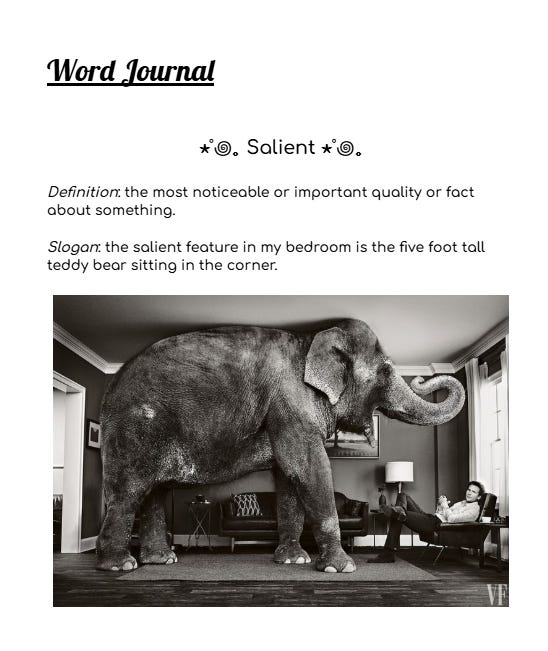
Think of this as a lifelong practice. Create a new version of the word journal every year, and keep them saved as distinct tabs within the document. Watch the list grow as you do.
The final but most important task is to get those words memorized. As I mentioned at the start of this article, repetition is still the basis. Repetition rituals vary from person to person, and you may customize yours as you like. Mine include:
→ Dedicating at least one week for each word. I refer to this week by the word I’m learning: “This week is salient period. Next week is dubious period,” and so on.
→ Devising a unique repetition-based activity for each day of that week. On day one, for instance, I might spend twenty or so minutes writing down sentences that feature the word in as many of its different forms as possible (example: salient in adjective form; salience in noun form). Day two might be an oral activity, such as recording myself talking (to myself) for ten minutes, about a previously selected topic, but under the condition that the new word is mentioned a certain number of times. One can get pretty creative with these activities—and they take hardly any time from the day.
→ On day seven, writing a one-page reflection on any topic—while using the new word at least once.
→ Using an accumulative method as the words grow in number. What this means is that by the time I finish week two, I will have learned two words: salient and, let’s say, dubious. On the last day of the second week, while writing the one-page reflection for dubious, I also make it a point to include the word salient somewhere. Then dubious and salient get to be featured in the reflection for the third week’s word—and so on. This way, I ensure that whatever progress I have made with the previous words is not forgotten. I keep them all in regular use.
My previous issue with the repetition method was that it had been rather misguided. I wasn’t going for the right words, to begin with; and even when I did practice, I used to forget definitions quick because I had no visual or personal signal to anchor my understanding of the word to. The issue, then, was with what was being repeated and with what clues, if any, I was doing such repetition.
Learning vocabulary has become not just easier, but also a splendidly more delightful pastime.
May we all persist on being “savourers of linguistic flavours,” and on showing our languages the love we have for them by learning them to heart.
Until next time,
Heba
What are your thoughts on this three-step technique to vocabulary learning? I’d love to hear them!
Know a logophile who might enjoy this read? Feel free to share below:
Love this, Heba! I definitely agree that anyone can enjoy a well-written, beautifully phrased, and aesthetically pleasing piece. We may not all recognize—or be qualified to—the technicalities behind it, but I can assure you it brings a sense of warmth and eloquence, something much needed these days, which often feel overwhelmed by irrelevant and overly simplistic speech.
I enjoyed reading this one!
This made me reflect on how I would sometimes highlight a certain word from a book I read just because it sounded nice. But then, I wouldn't do much with it after.
I do have some kind of word journal, but it's mostly used to nerd around the etymology of a word. I might "steal" some ideas from your method and incorporate them into my own.