
A Student and Professor Converse: What's the Role of Faith in the Humanities?
A dialogue on the erasure of Islam and Muslimness in humanities discourse


During the long but busy days of my undergrad program, I often sought refuge in a professor’s office. I would come in with a friend or two, bringing coffee and a handful of conversation topics. Sometimes we were there an hour, sometimes longer. We sat basking in a most pleasant talk, touching on course material, career and life advice, the ins and outs of the university.
When I graduated, these extracurricular sit-ins with my instructors were what I thought I would miss the most. I was right: too often now I find myself wishing to be in the company of a distinguished scholar, engaging in enlightening discussions on matters of mutual interest.
Recently, though, I had this wish fulfilled. A Substack user by the name of Asif Majid reached out to me early last month, offering kind compliments on my content before, to my delight, requesting a collaboration.
We agreed on a subject that captivated us both, grounded in his expertise as a professor and my enthusiasm as a lifelong student: the intersection of faith and the humanities. In four interacting mini essays, we discuss the way colonial history has erased Islamic and Muslim contributions to knowledge in the arts and humanities.
I learned much from this conversation, and though done digitally, I felt myself transported to one of those offices again.
About @Asif Majid, PhD
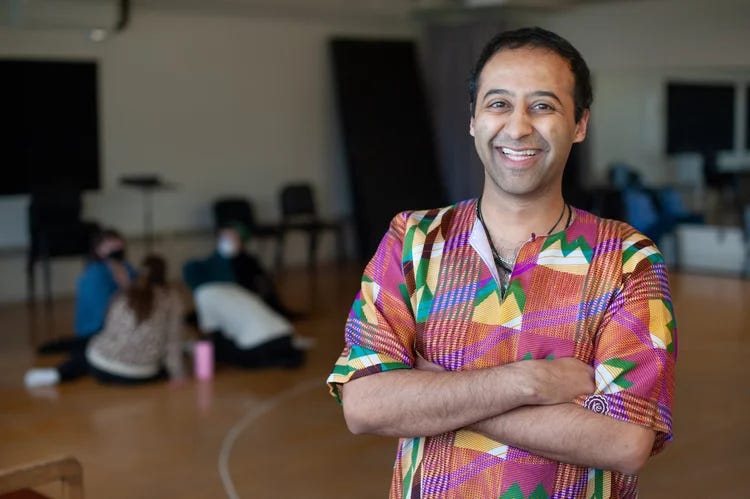
Asif Majid is a writer, theater maker, and scholar whose work sits at the intersection of Islam, performance, race, and social justice. He writes fiction, academic nonfiction, and plays, and works across community-based participatory theater and (auto)ethnography to examine how power, politics, and colonial legacies are lived, resisted, and reimagined. He is currently Assistant Professor at the University of Connecticut.
Asif’s artistic and scholarly practice centers communities often spoken about rather than with, addressing issues such as anti-Muslim racism, refugee movement, asylum and futurity—among much else.
He holds a PhD in Anthropology, Media, and Performance and an MA in Conflict Resolution. His forthcoming book, Making Muslimness: Race, Religion, and Performance in Contemporary Manchester, will be published by Routledge this year.
To follow up on his work, you may subscribe to his Substack (Deeds and Du’as) and visit his official website.
Asif is typing…
In some ways, I’ve been studying the humanities for generations. As a child, my father had aspirations to be a short story writer. My mother wooed him by writing poetry; he penned letters in response. Their transnational romance yielded a son who writes, even if neither of them do so that much anymore, the pressures of immigration grinding the glamour of creativity into dust.
In my early teen years, I attended a public school in the suburbs of Baltimore (in the US). There, I participated in a program called “Humanities,” a four-year curriculum of study connecting history, English, art, and music. I’d later come to understand that it was an interdisciplinary learning environment.
Over the four years, the time periods that we studied in history would be mapped onto a set of literatures that we’d read, accompanied by the study of music and art from that era. When studying medieval England, we read The Canterbury Tales. During the unit on early 20th-century US history, we listened to jazz. When investigating Chinese empires, my classmates and I tried our hand at calligraphy. Almost every time we read about an important civilization, we read works and engaged with creative forms that emerged from that epoch.
Except Islam.
Our unit on Islam was embarrassingly brief. It focused on the early history of the faith, gave outsized emphasis to the division between Sunni and Shi’a positions, and offered no connection between the past and the present. Islam was a religion stuck in time, one devoid of cultural meaning and significance aside from its place in the archive. It came from there, and that’s where it ought to stay—or so the message went.
Yet at the same time, I was called upon to correct the teacher when he said something different from my understanding of Islamic history. Whatever the dispute was, in the moment, I lost. I felt such rage at not being able to correct the teacher accurately, even as my heart burned with the injustice of some inaccuracy being foisted about my faith.
On the literature side of things, I don’t recall us even opening the Qur’an. We studied the Bible when learning about early Christianity and the time period in which Jesus (peace and blessings be upon him) was alive. And yet, even there, the Bible was not treated as a religious text. I distinctly recall my freshman English teacher emphasizing that we would be discussing the Bible “as a piece of literature” and not as a testament to faith.
Of course, much of this has to do with (back then, anyway) anxieties in US public education about keeping a separation between religion and education. But now, as a university professor teaching courses on theater, Islam, and social justice/human rights (and how all three of those things come together), a wondering remains for me: what is the role of faith in the humanities? And why do the humanities see Islam as such a boogeyman?
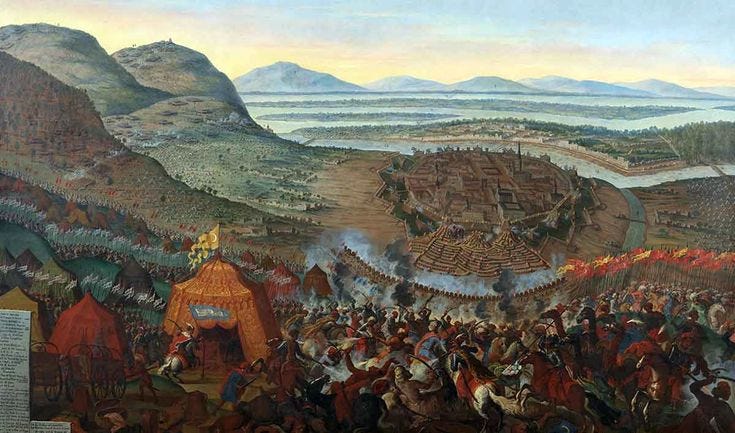
Much of this comes from a history of Orientalist discourse and narrative, dating all the way back to the Crusades, multiple battles over Jerusalem, and the strong anti-Muslim and anti-Islam sentiment that animated that violence, was perpetuated by it, and entrenched through it. The famous croissant, for example, was originally an Austrian bread developed in response to the Ottoman loss at Vienna in 1683: a crescent-shaped treat that allowed victorious Christians to symbolically devour the retreating Muslims.
The development of European culture, literature, and the arts have long been predicated on an anti-Islamic position (scholars like Tariq Ramadan, Talal Asad, and Edward Said have made this connection clear). This is even the case with the notion of secularism, which continues to take an anti-Islamic position while subtly uplifting Christian values (modern France is a good example of this).
All of this is despite the well-documented historical fact that the European Renaissance would not have ever come to pass were it not for Arab and Muslim intellectuals translating and building upon Chinese and Greco-Roman ideas, which they then passed on to European city-states through trade and mercantilism.
Perhaps this indebtedness is exactly why Europe is so afraid of Islam: because it knows, deep down, that Islam is actually what rescued Europe from the Dark Ages.
I didn’t know many of these things when I was learning interdisciplinary humanities in my high school classroom. But I can’t help but wonder: what might it have done to my capacity to embrace these histories if I saw and was taught, rather than had to fight for, my place in them? How much richer might our understanding of these histories be? And how might that contribute to a more respectful and accurate understanding of Islam and its beauty today?
Heba is typing…
What is the role of faith in the humanities?
This question called for a pause. “Faith” and “humanities” are two words my life has come to revolve around, but which I have been taught to think of as separate. Growing up, it did not occur to me that I could see religious value in the stories I read for entertainment; nor did I know that buried beneath enlightened European empires was the effort of scholars who, like me, called themselves Muslim.
Yet here is this nine-word question so casually stringing them together. Though I have given it much deliberation, I’m afraid that, for the most part, answering it is beyond me.
After all, I am rather new to the humanities.
It’s mighty embarrassing to admit I did not know what the word “humanities” meant as a high schooler. Not in its true sense, at least. My small-town high school taught a rigid curriculum that programmed me into thinking of the humanities as data for memorization. History was only a chronology of events I had to remember like headlines; philosophy was a list of ancient arguments I had to recite word-for-word before my classmates; and Arabic was the subject no one thought it necessary to study for—“it’s our native language,” the common excuse went, “how hard can it be?”
Literature, art, theater, religion—these were largely inexistent.
My institution’s (mis)treatment of the humanities was a natural product of a grade-centric educational system, a culture of metrics. Public schools in Lebanon are obliged to follow the governmental curriculum, which in its essence was designed to prepare students for official examinations held at the end of the senior year. How well a student performs on these national tests decides whether they make it to college and whether they earn scholarships.
Going to high school was thus a matter of learning how to answer the questions commonly posed in the Big Scary National Tests. Many educators believe that teaching students anything beyond that is overdoing it. I don’t recall reading a single novel (or short story, for that matter) for English class. We instead focused on soulless, government-curated essays and spent months learning how to replicate them. I graduated high school not knowing a single literary theory or movement. Names like Shakespeare and Dickens were just that. Names.
I am now reminded of an interaction I had with a teacher. It was my senior year, back in good ol’ 2019, and I had recently discovered that the building I had been frequenting for four years had a library. It was a small room, no bigger than a bathroom. There were shelves filled mostly with textbooks, but one little corner bore literary texts. Novels and plays. There was some Shakespeare, some Dickens.
Students weren’t allowed there (and honestly, I’m not sure I know why). But one day during recess I ventured out toward the little library, determined to fetch what would be my first Shakespeare. A teacher met me by the entrance.
Teacher: May I help you?
Me: I heard we’re allowed to borrow books from this room. I was hoping to do that.
Teacher (arching a brow): Which book?
Me: I don’t know. Something by Shakespeare.
Teacher (huffing out a dry laugh and ushering me away): You’re a senior. You should be focusing on your studies. What could you possibly want with Shakespeare?
And so back I went to those soulless essays.
Those English classes, I later realized, were there to teach us the language we needed for other subjects—to understand the English we encountered in maths, biology, chemistry, and physics.
Not to think critically, or write creatively, or appreciate literature.
Scientific subjects, on the other hand, were actually very well taught. The curricula were expansive, detailed. My school graduated students who were near science prodigies—kids who went on to become respected doctors and engineers. The humanities were thus there in service of those subjects. Students memorized history and wrote unoriginal essays in exchange for grades, boosting up their overall score and making it likelier for better colleges to admit them.
But nothing spoke service more than the fact that art and Islamic studies, in the rare semesters they were offered, often had their classes cancelled, replaced. It so happened that science teachers would realize they were running late with the curriculum and request extra sessions. And since art and religion were unimportant—not subjects the Big Scary National Tests tested students on—they could be easily sacrificed. I think I had fewer art and religion classes than the number of times I was absent from school. And I was hardly ever absent.
That religion classes were often done away with might have contributed to my belief that religious studies had nothing to offer to academia. It pushed my mind to compartmentalize faith and education into separate, distant corners.
Asif’s account of his high school experience with the humanities makes me feel the way I felt when, starting my B.A. in English at a university in Beirut, I discovered that many high schoolers in the capital and other cities (especially those from private institutions) had it different. Despite working toward the Big Scary National Tests as well, their teachers still taught them the humanities. They read novels and short stories. They made productions of Shakespearean plays. They debated in philosophy classes.
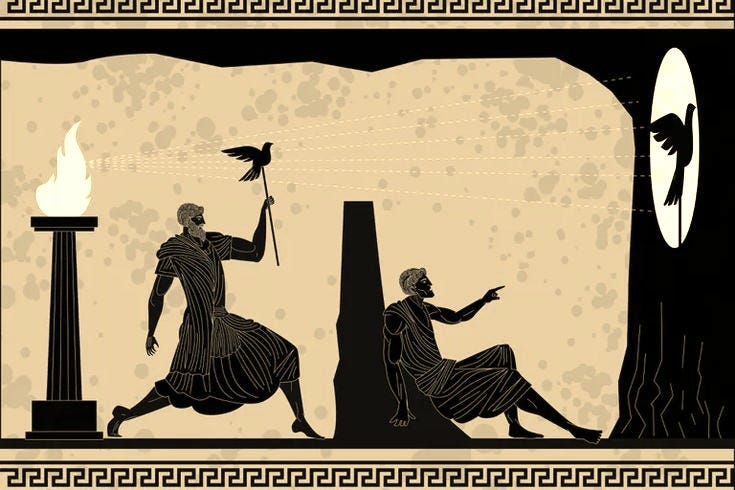
For years I had been the proverbial prisoner in Plato’s cave, mistaking the little I’d been taught of the humanities for the whole. But they were shadows. Just shadows.
What I felt then was a deep sadness over all I had missed out on. I felt behind.
To catch up, I had to put in extra effort—to learn the humanities from scratch. I had to become someone who read books not only for entertainment, as I had done throughout my childhood and teenage years, but critically.
It would take me another three years to start considering the role of faith in the humanities. After graduating university, I took up the works of JRR Tolkien. Seeing how he incorporated elements of his Christian faith into his narratives steered me into thinking about religion as something that’s indeed relevant to storytelling—to history, culture. I turned to my own beliefs and slowly began to undo the barrier I had set up all those years ago: Islam became a new lens through which I could analyze anything I learned.
And when that barrier came down, I was overwhelmed to find all that which mainstream culture had buried. All the knowledge Muslims have contributed. All the art they have made and the stories they have told.
Asif showed us what it’s like when a Muslim in the diaspora discovers the purposeful erasure of faith in formal education. I showed what it’s like when it happens in Muslim societies.
That question from before still begs for an answer. What is the role of faith in the humanities?
But I’d like to phrase it differently for Asif:
How does being Muslim affect your engagement with the humanities?
Asif is typing…
Heba’s essay makes me sad.
Primarily, this is because of how the humanities were so clearly instrumentalized in her educational context. The capacity for one thing, or one approach, to only ever be in service of another is deeply troubling. If, for example, we only ever see bread as a vehicle through which to deliver meat or hummus or another delicious delicacy, then the bread becomes a relegated afterthought rather than the star that it truly is.
Warm, delicious, soft—bread has the potential to be transformative with one’s first bite. And yet there are a hundred varieties, whole cookbooks and traditions and websites and TV shows and Substacks devoted to bread. Each one extols the virtues of a thing that, in ordinary and mundane hands and terms, is simply a vector for something else.
But what of that vector itself? What of (in case my bread metaphor isn’t clear) the humanities as a thing in and of itself, a thing in its own right? Here, I think, is where Heba’s question about Islam comes in. Because in my experience, having moved past the Eurocentric, Western, imperialist, and colonialist veil that painted the humanities as something Islam has nothing to do with, I now can’t unsee the centrality of the faith to humanistic knowledge and its production.
Take, for instance, Palestinian critical theorist Edward Said’s Orientalism. I’ve been thinking about it a lot lately, especially as I’ve been called to deliver a number of anti-Muslim racism trainings to audiences of non-Muslims, primarily white folx. The basic premise of Said’s framework is that “the East” has been imaginatively and materially (and politically, militarily, and economically) constructed by “the West” as the place where Islam is located. And that “the East” is backward, barbaric, angry, violent, extreme, hypersexualized, Other, exotic, foreign, alien, ignorant, and so on. And that the construction of “the East” in this way renders “the West” possible, because it makes European anxieties about what it actually is something that doesn’t require internal reflection. Rather, it simply requires representing Europeanness against “the East” (and therefore against Islam and so on and so forth).
European colonial power has been so totalizing for so long that all of us are infected by these logics, no matter where in the world we are. Heba’s mention of me as a Muslim “in the diaspora” is a perfect example, for it implies that Muslims, Islam, and Muslimness don’t belong in “the West,” even though Islam is a global faith. This isn’t to take issue with Heba (she’s wonderful!), but rather to demonstrate how we are all affected by this thinking.
The way in which the Western humanistic world (and beyond, I’d argue) have imaginatively constructed Islam is myopic, limiting, and narrow-minded.
As a result, when I go to train folx on anti-Muslim racism, for example, or when I encounter theater or anthropology or history books (in my current area of research), there are often degrading, damaging, totalizing and sweeping statements. A popular theater history textbook in the US, for instance, claims that in the world of theater and performance, Islam is largely “a negative force”—as if we do not perform salaat or hajj or fasting or whatever else with hearts and minds turned to Allah as Divine audience. What is performance if not performers and an audience in a space?
Western arrogance about what constitutes truth and who gets to claim it delimits and limits perceived Islamic contributions to the humanities, writ large, arguing that Islam has no place in the European or humanistic canon.
Nonsense.
The upshot of hearing this lie so often is that we, as Muslims, start to believe it. It is repeated through film and media, in the alleged supremacy of the STEM fields, on the news, through who and what is funded, through educational systems and how we teach the next generation, and so on. We start to internalize an attitude of inferiority, an attitude that I find myself constantly fighting as a professor in a primarily white university. People are nice and respect my research, but at the heart of it, they do not understand the intimate and innate historical and contemporary intersections between the Crusades, the Renaissance, European colonization, Orientalism, anti-Muslim racism, white supremacy culture, and Far Right discourse and politics.
Until we see all of these as intertwined, it is impossible to recognize and uplift the centrality of Islam to the humanities.
So how do I answer Heba’s question, ultimately? My faith is fundamentally tied to what it means (to me) to be a critical scholar, thinker, and educator. The Prophetic tradition and that of the Holy Household consists of exactly that: to critique and push back against sociohistorical and political structures of oppression, wherever and however they appear.
My Substack is my latest attempt to do so, outside and beyond “the academy.” We need a more public and regular and critical discourse on and about and around the centrality of Islam in everyday life, whether that’s found in lived realities or historical writings. It’s not enough to study the humanities as a thing on its own. We must also recognize what has been distorted and destroyed in the building of that, now sacrosanct, edifice.
In whatever happens, I pray that Allah continues to guide me and others to make such recognition and critique possible.
Heba is typing…
Asif’s response forced me to reconsider how well I thought I knew Orientalism.
The word was a constant in my postcolonial literature class. It was our go-to theoretical framework when analyzing imperialist themes in nineteenth- and twentieth-century fiction. Our professor had us use it to correct the language of political speeches she showed us—then called us out if we said “Middle East” or “MENA” instead of “SWANA” in our interactions. We saw how naturally Eurocentric terminology seeped into academic discussions. Strangely enough, though, I did not see or heed the way it permeated the intimacy of my social life. I was content thinking of it as an abstract historical problem to be dealt with inside the classroom.
Yes, “the West” has produced “the East” as its cultural, religious, and moral Other; but when Asif paused on my mention of him as a “Muslim in the diaspora,” I became aware of another kind of othering I have spent years absorbing within the communal life of my small Lebanese village. I have sometimes heard it said or insinuated that Muslims abroad, particularly those in Europe and the United States, practice a compromised Islam—one adulterated and “modernized” to fit a Western lifestyle. Such talk has helped normalize the idea that the Islam practiced by Arabs is more authentic than that of Muslims elsewhere, despite Islam itself neither belonging to a geography nor being reducible to ethnicity.
It’s an erroneous idea, but I don’t think those who hold it do so out of conviction. It’s more of a defense: “the East” has been persistently ostracized for hundreds of years, and as a consequence it has developed a protective claim over Islam as property. I am reminded of what Frantz Fanon argues on the topic of colonial violence—that it produces defensive essentialism. When a people are repeatedly dehumanized, the subject of their Otherness (in this case, Islam) becomes a refuge—but soon what begins as protection transforms into possession.
It is from within this atmosphere, or its legacy, that words such as “diaspora” slip imperceptibly into speech. Many of us continue to absorb the idea that Islam has a homeland. Now that I see it echo in my own words and conversations, I can attest to what Asif has observed about the insidious and ubiquitous nature of imperialist ideology.
And I think this is where the danger lies in separating faith from the humanities at the level of method and formation. As long as we are kept from seeing how Islam was historically involved in the production of art and knowledge—particularly those that today form the so-called Western canon—the more certain “the East” becomes that Islam has no place in “the West.” And the more entrenched this certainty grows, the deeper this internalized division between Arab and non-Arab Muslims becomes.
In other words, intellectual erasure is capable of enabling social fragmentation. It is an especially depressing thing when Islam is meant to be our one unifying horizon.
That said, what does it really mean to recognize Islam’s centrality to the humanities?
I don’t think it is a matter of inserting Islamic themes into every text, nor is it about proving Islam “belongs” by tallying achievements and turning humanities discourse into religious apologetics. Rather, it is a matter of employing Islamic knowledge for two purposes: first, the correction of distorted histories; and second, an engagement with the humanities that is more humane.
The latter function especially resonates with me, not only as a lifelong student but as someone who is still learning to undo the barrier I once believed existed between faith and education.
It requires looking into some of the values Islam upholds when it comes to knowledge-seeking. Take the practice of tadabbur as an example. It instructs us that Qur’anic reading ought to be slow and recursive. Meaning is not exhausted in one encounter; we return to the same verses again and again, and are changed by them each time. If a similar discipline is applied to our study of the humanities, we become inclined to resist speed-reading and the flattening of texts into mere arguments.
Tadabbur also trains us to reconsider the value of what is read. Islam tells us that knowledge is not neutral and that it is judged by what it does to the learner (I have written briefly on this idea within the domain of fiction reading and writing). When applied to other domains, tadabbur redirects us toward questions such as: What kind of person does this knowledge form? and does it model ethical responsibility? i.e., it helps us prioritize intention over output, approaching knowledge as a kind of trust—as an amanah—rather than possession.
This is how being Muslim has so far influenced my engagement with the humanities. This is part of the Prophetic tradition Asif references: Islam as a method to rectify the intellectual erasures of the past, but also to build toward a more ethical and intentional future in our own and others’ educational pursuits.
Returning to Asif’s beautiful bread metaphor, I propose that if bread represents the humanities, then Islam is the technique. It’s the process of kneading, allowing the dough to rest, and then sharing it. Without it as a method, the same ingredients produce something entirely different.
May Allah (Exalted is He) allow us to nourish ourselves and others through our sincere pursuits.
We could go on in many more mini essays, but we brought it to an end with a supplication and with hopes for a more just representation in future academic discourse.
Writing this back-and-forth with Asif has been truly an enlightening experience, and I’m grateful for the opportunity to share it with you. There is so much I didn’t and still don’t know, so much to learn. I feel only encouraged to further study this topic—and I hope it has done the same for you.
Besides Orientalism, Asif recommends Anouar Majid’s We Are All Moors as a book to begin this pursuit with. Another of my subscribers has also pointed to the works of Wael Hallaq (whom I hadn’t known before, despite sharing my surname!).
May Allah bless our continuous efforts to learn, to rectify, and to understand.
Until next time,
Heba
What are your thoughts on the role of faith in the humanities?
What do you think of the historical erasure of Muslim contributions to global knowledge?
Know someone with whom this might resonate?
 | A guest post by
|
I really appreciated this exchange — especially how it shows that “faith in the humanities” isn’t about turning everything into apologetics, but about recovering what was erased and changing the method of reading and knowing (that tadabbur/amanah framing landed hard for me). The point about how intellectual erasure can quietly produce social fragmentation felt painfully true, and I love how you both refuse the cheap binary where Islam is either “outside” the canon or only allowed in as a footnote. It made me want to slow down and read more carefully, with more honesty about the inherited language we carry. I’ve been writing about something related — presence, meaning, and how love changes the way we read the world — if you’d like to read it here: https://theeternalnowmm.substack.com/p/eternal-love?r=71z4jh
This is my first time reading your works. And this is the first of your posts I'm reading. It's just so beautiful, like SubhanAllah, the depth of the conversation is enlightening. I'm a humanities student as well, and I can relate to this respected professor. I also had the same questions, such as why there isn't much Islamic literature at my university, which used to be a madrasa... the irony.